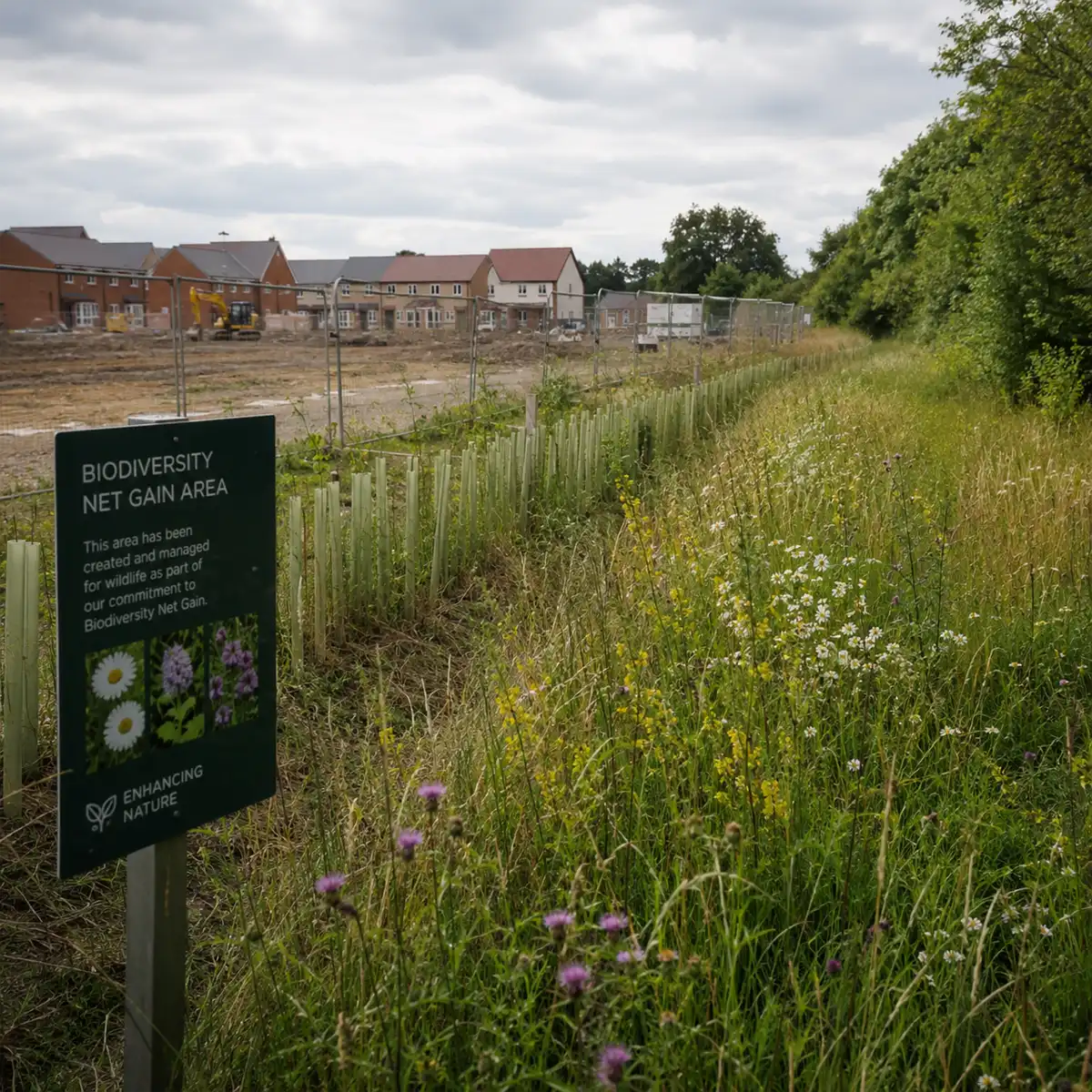
Two years after it became mandatory, Biodiversity Net Gain is reshaping how English developers approach the planning system. Since 12 February 2024 for major developments, and 2 April 2024 for small sites, almost every planning application in England has needed to demonstrate at least a 10% improvement in biodiversity value, measured against a statutory baseline and secured for at least 30 years. The requirement sits in Schedule 7A of the Town and Country Planning Act 1990, inserted by Schedule 14 of the Environment Act 2021. It applies whether the developer is building two houses on a brownfield infill or 2,000 homes on a greenfield extension.
The framework is still settling. The de minimis exemption threshold of 0.2 hectares takes effect on 31 July 2026, removing roughly half of residential applications from BNG scope. Mandatory BNG for Nationally Significant Infrastructure Projects, originally scheduled for May 2026, was confirmed by the government in 2026 for an implementation date of 2 November 2026. A National Audit Office report in 2024 documented widespread industry support but also significant delivery and capacity concerns. The picture in mid-2026 is of a regime functioning, recognised as important, and still being calibrated in motion.
What Biodiversity Net Gain actually requires
Biodiversity Net Gain requires most developments in England to deliver a minimum 10% increase in biodiversity value, measured by the statutory biodiversity metric and secured for at least 30 years. The requirement is set out in Schedule 7A of the Town and Country Planning Act 1990, inserted by the Environment Act 2021. Natural England administers the framework.
The mechanism is procedural rather than ecological in its first instance. A developer submits a biodiversity gain plan as part of their planning application. The plan uses the statutory biodiversity metric, currently DEFRA Metric 4.1, to convert habitat areas and wildlife features into standardised biodiversity units. The plan must show how the post-development site will score at least 10% higher than the pre-development baseline in biodiversity units. The plan is then secured legally, usually through a Section 106 agreement or a conservation covenant under the Environment Act 2021, before the development can proceed.
The 30-year management requirement is the longest-duration habitat commitment in English planning law. It runs with the land regardless of subsequent ownership changes. Failure to deliver the secured gains is enforceable by the local planning authority under standard planning enforcement powers, and in the case of off-site gains, by Natural England through the conservation covenant. The 30-year horizon was deliberately set to match a working ecological timeframe: most habitat creation reaches reasonable maturity within that window, but not significantly beyond it.
How the statutory biodiversity metric works
The statutory biodiversity metric is a spreadsheet calculation tool, designed by Natural England and maintained by DEFRA. It converts physical habitat into units that can be compared like-for-like. The metric measures four properties of any habitat: size in hectares, condition assessed against published criteria, distinctiveness scored on a low-to-high scale, and strategic significance based on local nature recovery priorities. Multiplying these together produces a biodiversity unit score for the habitat as it currently exists.
Habitat units, hedgerow units, and watercourse units are calculated separately. A site cannot offset hedgerow loss with woodland creation, or watercourse damage with grassland improvement. The principle is that like must replace like, with a clear preference for habitat enhancement of the same type. This is one of the metric's most significant design features: it prevents developers from cherry-picking the lowest-cost biodiversity creation route at the cost of habitat-specific decline.
A small sites metric exists as a simplified version for minor developments, removing the more complex calculations that would not be proportionate to the development scale. Both metrics are publicly available, free to use, and form part of the validation requirements at the planning application stage. The 10% gain is calculated against the baseline, meaning a site that scores 100 units before development must achieve at least 110 units afterwards, regardless of how those units are delivered.
The three delivery routes developers must work through
Developers must work through three biodiversity delivery routes in strict statutory order. First, create or enhance habitat on the development site. Second, deliver off-site biodiversity gains on the developer's own land or by purchasing units from a registered habitat bank. Third, as a last resort, purchase statutory biodiversity credits sold by the government through Natural England.
The hierarchy is not optional. The legislation requires developers to exhaust the higher-priority routes before moving to the next, and to evidence that exhaustion in the biodiversity gain plan. On-site delivery is preferred because it produces ecological benefit close to the original habitat loss; off-site delivery is acceptable when site constraints make on-site impractical; statutory credits are designed to be expensive enough to function as a credible backstop rather than a default route. As of early 2026, the statutory credit price was set high relative to off-site unit prices precisely to maintain that hierarchy.
Off-site delivery is administered through the national register of biodiversity gain sites, maintained by Natural England. Habitat banks, typically operated by ecological consultancies or land managers, create and register units that developers can purchase to satisfy their gain plans. The off-site units market is still maturing. Liquidity varies by region and habitat type. Where on-site delivery is impossible and local off-site supply is thin, developers can find themselves pushed toward statutory credits even on developments where that was not the intended outcome.
Where implementation has been hardest
The National Audit Office's 2024 review of BNG found widespread support for the policy alongside three categories of implementation concern. The first was local planning authority capacity. Most local authorities now require ecological assessment of every BNG application, and many do not employ in-house ecologists. The NAO noted that authorities were relying heavily on developer-commissioned ecologists, with limited capacity to challenge the resulting plans. The Parliamentary Office of Science and Technology revisited this finding in its 2026 update, noting that capacity had improved but remained uneven across regions.
The second concern was monitoring. A 30-year obligation requires monitoring across that 30-year period, and the systems for tracking BNG outcomes beyond the planning approval stage are still being built. Natural England has the statutory role but limited resources for hands-on monitoring of thousands of small individual sites. The 2026 round of secondary legislation under the Environment Act 2021 is expected to clarify monitoring and enforcement responsibilities further, though specific dates have not been published at the time of writing.
The third concern was viability. Developers, particularly small builders, have argued that BNG costs squeeze project margins on already-tight residential developments. The de minimis exemption announced in December 2025 and confirmed for 31 July 2026 is the government's first concession to that argument. Sites with a red line area of 0.2 hectares or below will be exempt entirely, which the Department for Environment, Food and Rural Affairs estimates will remove roughly 50% of small residential applications from BNG scope. Larger sites and major developments remain in scope without change.

How NSIPs join the framework in November 2026
Nationally Significant Infrastructure Projects sit outside the Town and Country Planning Act 1990 regime. They receive Development Consent Orders under the Planning Act 2008 rather than planning permission under the TCPA. BNG was therefore not part of the original 2024 mandatory regime. The Environment Act 2021 included provision to extend BNG to NSIPs by secondary legislation, and the consultation on that extension closed in 2024.
The government confirmed in 2026 that mandatory BNG will apply to NSIP applications submitted on or after 2 November 2026. The original May 2026 date was pushed back to give DEFRA and Natural England time to finalise the supporting guidance. A uniform 10% net gain requirement will apply across all NSIP sectors, with no sector-specific exemptions. Targeted BNG boundaries will allow assessment within the developable footprint rather than the full red line of an NSIP, recognising that linear infrastructure projects (rail, transmission, pipelines) span large areas where blanket assessment would be impractical.
The temporary habitats provision, by which land disturbed during construction and restored within two years is not treated as lost within the metric, will be extended to NSIPs. DEFRA is also consulting on extending the two-year rule to five years for NSIP applications, reflecting the longer construction timelines typical of major infrastructure. The implications for projects such as Sizewell C, Hinkley Point C, and the proposed new transmission corridors connecting offshore wind to the grid are significant: BNG considerations will need to be embedded from the conception and site-selection phase rather than added in late.
Where the policy remains contested
Three policy debates sit on contested ground rather than settled view. The first concerns whether 10% is the right level of net gain. The Wildlife Trusts and several environmental NGOs have argued that 10% is the floor and that local planning authorities should be encouraged to set higher local standards. Some authorities, including Lewes District Council, have adopted 20%. The Home Builders Federation has argued that any uplift above 10% creates regional disparities that distort the housing market without proportionate biodiversity benefit. The evidence base on whether higher local standards deliver materially better ecological outcomes is still developing.
The second debate is on off-site delivery. Environmental groups have raised concerns that off-site units risk concentrating biodiversity gains in cheap rural locations far from the urban areas where habitat loss is occurring, producing measurable metric improvements but uneven ecological distribution. Habitat bank operators counter that strategic ecological networks deliver more durable gains than fragmented on-site provision. The Local Nature Recovery Strategies, statutory documents under the Environment Act 2021 setting regional ecological priorities, are intended to bridge this question by routing off-site gains into the places that matter most for each region.
The third debate is on irreplaceable habitats. Ancient woodland, ancient hedgerows, blanket bog, lowland fen, and certain other habitat types are designated as irreplaceable, meaning their biodiversity value cannot be made good through the metric. The policy currently requires developers to avoid impacts on irreplaceable habitats wherever possible, with explicit ministerial approval needed for unavoidable impacts. Whether the irreplaceability list should be expanded, and how it interacts with the wider net gain calculation, remains under review at DEFRA.
Fun fact: England is one of only a small group of countries worldwide with a mandatory biodiversity net gain regime built into the routine planning system. Most comparable jurisdictions rely on case-by-case environmental impact assessment rather than a statutory metric.
What to watch for the rest of 2026
Three implementation milestones will shape the next twelve months of UK Biodiversity Net Gain delivery. The 0.2-hectare exemption comes into force on 31 July 2026 and will reshape the application mix substantially toward larger sites. Mandatory NSIP coverage begins on 2 November 2026, bringing major infrastructure within the framework for the first time. The next round of secondary legislation under the Environment Act 2021 is expected to address monitoring, enforcement, and the future treatment of irreplaceable habitats. None of these milestones resolves the deeper question of whether a metric-based system delivers the ecological outcomes its supporters intend. The 30-year horizon means honest answers will arrive slowly. For developers in the meantime, the practical advice is unchanged: design for biodiversity at the conception stage, not as a planning condition added on at the end.
Continue Reading
All articles →Newsletter
Stay updated on Digital News