How New Mayoral Powers Could Speed Up London Tube Projects
If you have followed London Tube projects over the past decade, you will recognise the pattern. Big promises come with big maps, but then reality bites through funding gaps, legal processes, and political timing. The question in 2026 is not whether London needs new rail capacity, but whether new devolution plans and City Hall authority can meaningfully shorten the path from announcement to spades in the ground.
The short answer is that London is moving towards faster local decision-making in some areas, but claims about sweeping, automatic fast-tracking need careful scrutiny against what legislation actually changes and what still resides with central government, regulators, and the courts.
Any acceleration will depend on three things working together. First, what powers Parliament ends up granting. Second, what funding is secured, and on what terms. Third, how Transport for London and boroughs handle consultation, land, and construction risk without losing public trust.
Understanding How New Powers Could Accelerate London Tube Projects
The English Devolution and Community Empowerment Bill is designed to push more decision-making and accountability out of Westminster and towards local and regional leadership. The Bill was published on 10 July 2025, with parliamentary steps following later in 2025, which matters because the final shape of powers is determined in that process, not in political slogans.
In plain terms, the Bill's logic is that stronger local institutions can make and deliver policy faster because they sit closer to local needs, land constraints, and public services. The explanatory notes frame this as a move towards clearer responsibilities for "strategic authorities", with the expectation that local places can plan and deliver more coherently across housing, skills, transport, and growth.
A crucial detail is that "more devolution" does not automatically mean "less process". Big infrastructure still triggers statutory consultation, environmental assessment, procurement rules, and potential legal challenge. Any speed gain comes from reducing duplication and uncertainty, not from removing checks entirely.
Current Approval Process for Major London Tube Projects
Major rail schemes in England sit inside a legal and administrative architecture that was built to balance delivery with scrutiny. The Transport and Works Act 1992 is a key part of that picture, but it is not the only route. Some projects need Transport and Works Act Orders, others go through planning regimes, and the very largest can end up requiring hybrid legislation. The point is that London's "approval timeline" is not a single switch that a Mayor can flip.
The Bill timeline is itself a data point about how change happens in practice. Publication on 10 July 2025 and subsequent parliamentary stages in 2025 show that the system remains parliamentary first, even when the political story is framed as local empowerment.
This is where a lot of public confusion starts. Commentators often treat "devolution" as a direct transfer of sign-off power for specific transport orders. In reality, reforms tend to work in narrower ways, for example, by clarifying who sets policy, who funds what, who consults, and who is accountable when something goes wrong. Those details determine whether time is saved at the front end or merely moved around the system.
Realistic Timeline for Deliverable London Tube Projects
Claims about a sudden pipeline of "mega" schemes becoming imminent should be tested against what transport bodies are actively taking through governance. A practical way to do that is to look at what is appearing in formal committee papers and forward plans, because those documents reflect internal scheduling, oversight, and delivery readiness more than press conference language.
The Transport for London committee, reporting in December 2024, referenced workstreams connected to schemes, including the West London Orbital, in the context of programme delivery updates. The same public reporting pack also recorded projects dependent on Department for Transport approvals, with construction timing tied to those decisions, including references to March 2025 as a conditional start point for one programme element.
By late 2025, TfL's published forward planning for its investment governance continued to show multi-year sequencing across upgrades, renewals, and enhancements, dated "as at 30 September 2025" and published on 8 October 2025. That kind of document does not guarantee delivery, but it does show what the organisation expects to take through decision points across 2026.
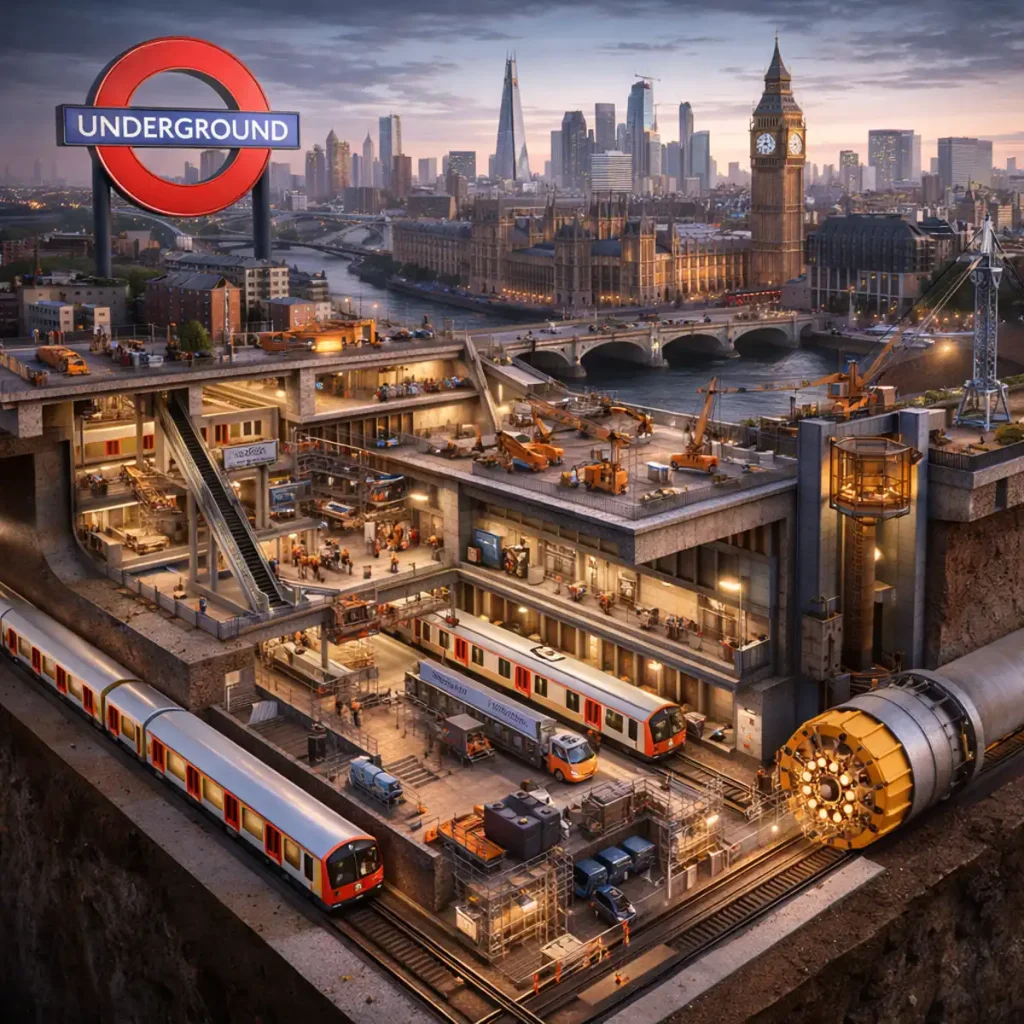
The implication for Londoners is blunt. Even if City Hall gains marginally faster internal pathways, the delivery critical path is still shaped by funding certainty, land and utilities, station constraints, rolling stock procurement, and construction capacity. Faster permission does not dig tunnels by itself.
Funding Requirements for Future London Tube Projects
The most reliable accelerator for rail projects is boring but decisive. It is stable capital funding and a credible plan to manage risk. Without that, new powers can become a political ornament rather than a delivery tool.
One widely cited benchmark in the current debate is the scale of capital renewal money discussed around the 2025 spending review period, including references to a £2.2bn capital renewals envelope for TfL. The point is less the headline number than the strategic effect. When renewals and upgrades have a defined multi-year runway, engineering teams can plan procurement and possession schedules with fewer stop-start cycles, which is where hidden delay often lives.
The devolution Bill's broader policy case also uses quantified claims. One published briefing on the Bill references an expectation of £38m per year in benefits and associated housing and growth impacts, which shows the kind of economic framing ministers use to justify devolved arrangements. Even if you disagree with the modelling, the presence of numbers matters because it shapes what Parliament and the public will demand in delivering evidence.
Funding innovation ideas, such as capturing uplift in land value near stations, are often discussed as if they are quick win. In practice, each mechanism is contested, technically complex, and politically sensitive. The key test for London will be whether any new settlement reduces risk volatility, or merely transfers it from central government to City Hall.
Transparency Challenges in Fast-Tracking London Tube Projects
Speed is politically popular, but legitimacy is operationally essential. If London tries to compress timelines without visible checks, it invites legal challenge, community backlash, and reputational damage that can slow projects more than any Whitehall delay.
A realistic scenario looks like this. First, a project team uses clearer devolved roles to reduce duplication between institutions. Second, consultation is tightened and better targeted rather than shortened to the point of distrust. Third, the public record becomes more legible, with fewer opaque hand-offs. Those are the kinds of gains devolution can support, provided governance is robust.
The Bill's overall direction is to make local leadership more responsible for outcomes, not simply more powerful in theory. That is a governance trade. When a Mayor can claim credit for speed, the same Mayor also owns the consequences of cost escalation, disruption, and underdelivery.
Fun fact: The Transport and Works Act dates to 1992, and its consent orders still shape how many UK rail schemes get legal permission to be built.
[INTERNAL LINK: how infrastructure consents work in the UK | planning and transport consent systems]
What the Next 18 Months Could Mean for London Tube Projects
The most plausible near term impact is not a sudden explosion of brand-new lines, but a tightening of the pipeline. The projects that move first will be the ones with credible business cases, prepared land strategies, and governance pathways already mapped through TfL committees and partner bodies.
TfL's forward planning, published in October 2025, points to an organisation sequencing upgrades and renewals through 2026 and beyond. That is the context in which any "fast tracking" claim should be read. The system can move more quickly at decision points, but only where the groundwork is already done.
For Londoners, the practical question is what changes they can observe. Watch for published consultation timetables, procurement milestones, and funding agreements that extend beyond single-year horizons. Those are harder to spin than speeches and more predictive than slogans.
Conclusion
New mayoral powers may help London move faster in specific parts of the system, especially where roles are clarified and duplication is reduced. But London Tube projects will still rise or fall on funding certainty, deliverability, and public legitimacy. The devolution Bill, published on 10 July 2025, gives the debate a legal vehicle, yet the details and the trade-offs will decide whether London genuinely saves time or simply shifts responsibility.
In the end, rail delivery is like rebuilding a moving machine. You can speed up the planning table, but the city still has to keep running while the work happens.
Continue Reading
All articles →Newsletter
Stay updated on Digital News