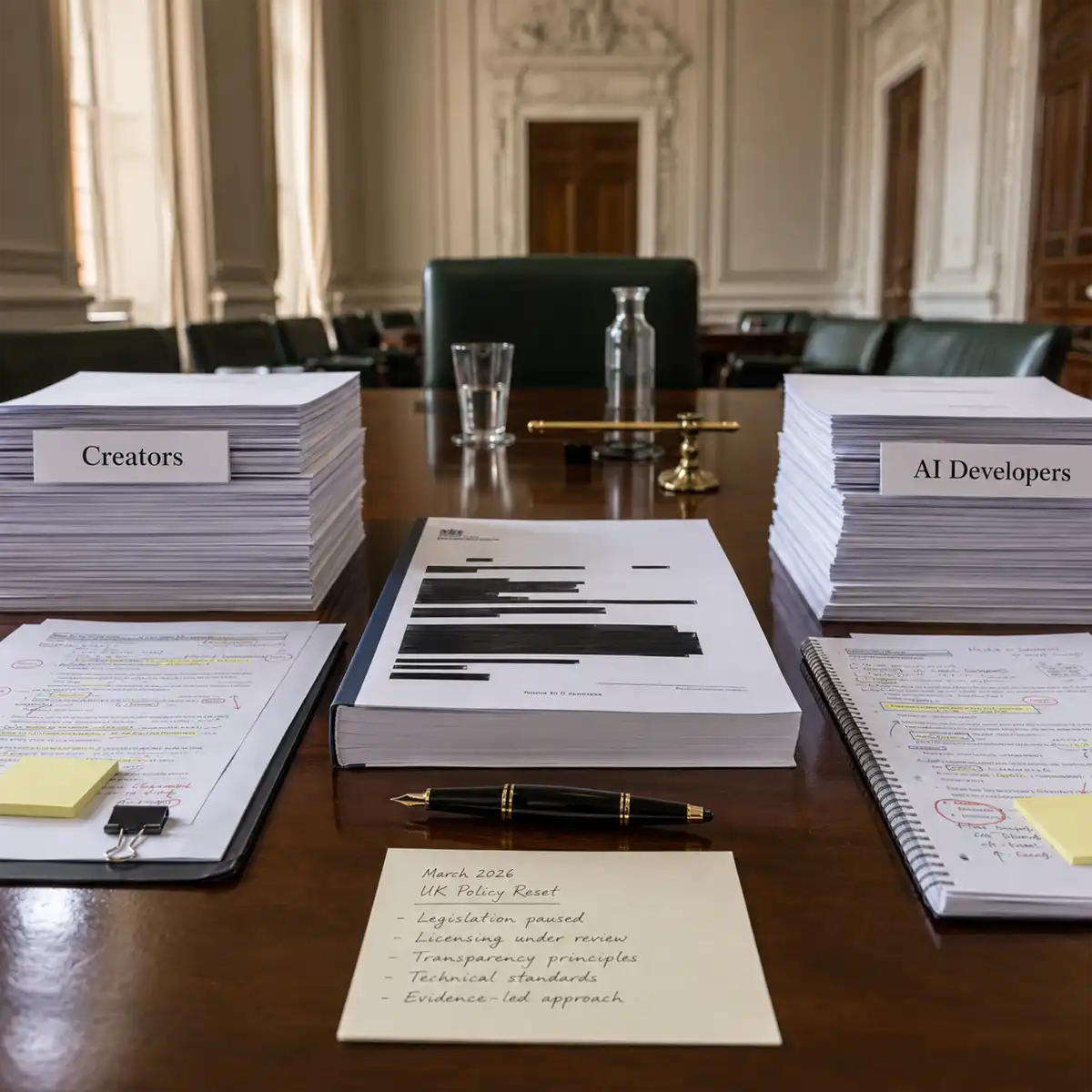
The state of UK Copyright Law and AI entered a new phase on 18 March 2026, when the government published its Report on Copyright and Artificial Intelligence along with a written ministerial statement from Liz Kendall, Secretary of State for Science, Innovation and Technology. The Report was required by sections 135 and 136 of the Data (Use and Access) Act 2025, following a public consultation that ran from 17 December 2024 to 25 February 2025 and received over 11,500 responses. The government confirmed that it no longer has a preferred policy option, set aside the text and data mining exception with opt-out model it had previously proposed, and made clear that it will not legislate at this stage. On the fundamental question of whether training an AI model on copyright-protected works without authorisation infringes UK copyright, the law remains where it was in early 2024.
Running alongside the policy debate is the first UK judgment on AI and copyright. On 4 November 2025, Mrs Justice Joanna Smith handed down her decision in Getty Images (US) Inc & ors v Stability AI Limited [2025] EWHC 2863 (Ch), dismissing Getty's secondary copyright infringement claim while upholding limited and historic findings of trade mark infringement. Getty was granted permission to appeal that decision on 16 December 2025. This article sets out how UK copyright law applies to AI-generated works in 2026, how the Getty judgment leaves the central training-data question open, and what the March 2026 policy reset means for creators, AI developers, and UK businesses.
What UK copyright law actually says
The primary statute is the Copyright, Designs and Patents Act 1988, the CDPA. Copyright arises automatically in original literary, dramatic, musical, and artistic works, as well as in sound recordings, films, broadcasts, and typographical arrangements. Infringement comes in two broad categories: primary infringement, which covers direct acts of copying, issuing, communicating, or adapting the work in the UK; and secondary infringement, which covers the importation, possession, or commercial dealing in the UK with an 'infringing copy' of a copyright work.
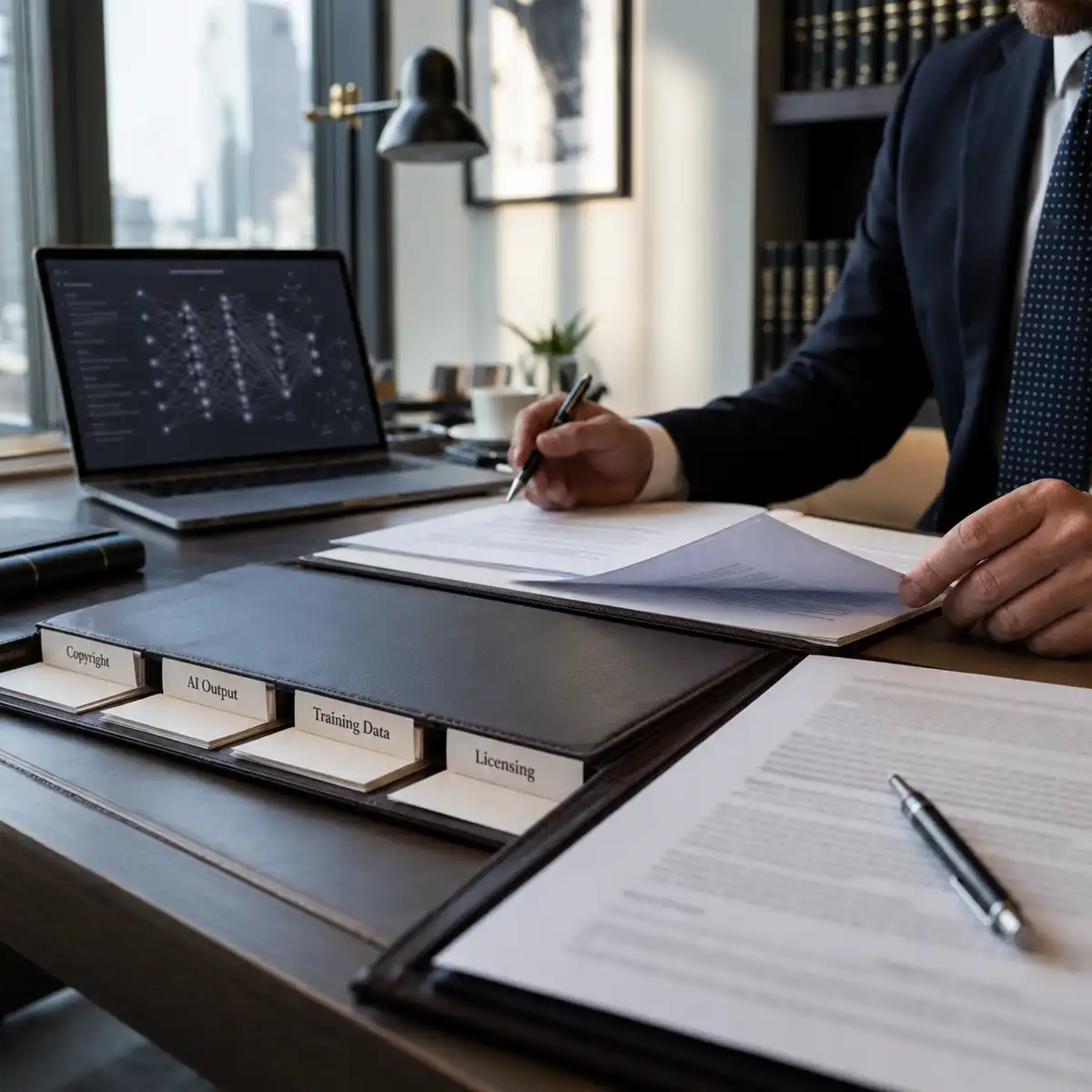
For AI, two provisions matter more than the others. The first is section 17, which defines 'copying' broadly to include reproduction in any material form, including storing the work in any medium by electronic means. That is wide enough in principle to catch the download-and-process steps involved in training an AI model on copyright material. The second is section 29A, inserted by the Copyright and Rights in Performances (Research, Education, Libraries and Archives) Regulations 2014, which provides a text and data mining exception for non-commercial research purposes. Commercial AI training falls outside section 29A. There is no general commercial TDM exception in UK law, which is the central statutory fact behind the entire policy debate.
Section 9(3) of the CDPA contains an unusual provision that the UK has retained while other jurisdictions have moved away from it. For 'computer-generated works', meaning works generated by a computer in circumstances where there is no human author, the author is 'the person by whom the arrangements necessary for the creation of the work are undertaken', and copyright subsists for 50 years from the year the work was made. In principle this provides a route for a person who commissioned or operated an AI model to claim authorship of its outputs. In practice the UK case law on section 9(3) is thin, and academic commentary has long argued that the provision sits uneasily with the general UK requirement that copyright works involve original human intellectual effort.
How UK copyright law handles AI generated works
UK copyright law applies to AI-generated works through the Copyright, Designs and Patents Act 1988. Training AI models on copyright works may infringe without permission or a licence. Section 29A allows limited non-commercial text and data mining. Section 9(3) can vest authorship in the person arranging creation of a computer-generated work, for a 50-year term.
That summary is the operational position as of April 2026. It is not the position everyone in the debate wants. Creators' organisations argue the existing framework under-protects their rights in practice because of the difficulty of enforcement against overseas training. AI developers argue that the absence of a commercial TDM exception puts UK-trained models at a competitive disadvantage compared to those trained in permissive jurisdictions. Both positions contain truth. The government's March 2026 decision not to legislate preserves the ambiguity.
What the Getty v Stability AI judgment actually decided
The Getty litigation is the first substantive UK judicial treatment of the interface between copyright and AI. Getty Images issued proceedings on 16 January 2023 alleging that Stability AI had used more than 12 million Getty images scraped from its websites without authorisation to train the Stable Diffusion image-generation model, and that the making and use of the model in the UK therefore infringed Getty's copyright, database rights, and trade marks. By the end of the trial, Getty had abandoned its primary copyright infringement and database rights claims, principally because it had not been able to adduce evidence that the training of Stable Diffusion took place in the UK; the model had been trained overseas.
What remained for the court was a secondary copyright claim under sections 22 and 23 of the CDPA and a trade mark claim. On the copyright claim, Mrs Justice Joanna Smith held that an 'article' for the purposes of secondary copyright infringement does not have to be tangible: the concept is capable of covering an electronic copy stored in an intangible form, such as an AI model or its weights. That is a significant finding in its own right. However, the judge held that Stable Diffusion does not, and has never, stored or reproduced any copy of Getty's copyright works; its weights and biases were altered by exposure to the works during training, but the works themselves were not retained in the model. On that basis, Stable Diffusion could not be an 'infringing copy' for the purposes of the secondary infringement provisions, and Getty's copyright claim failed.
The trade mark claim had a narrower success. Historic versions of Stable Diffusion had generated synthetic images displaying the Getty watermark, which in limited circumstances constituted trade mark infringement where the outputs could cause customer confusion. The judge held that Stability AI, as the party with ultimate control over the datasets used to train the model, bore responsibility for the trade mark infringement rather than the user who typed the prompt. The overall commercial outcome favoured Stability: Getty was ordered to pay 69.4% of Stability's costs, including an interim payment of approximately £4.4 million.
On 16 December 2025, Mrs Justice Joanna Smith granted Getty permission to appeal the dismissal of its secondary copyright claim, accepting that the appeal had 'a real prospect of success' and that the underlying question of whether an 'article' must contain a copy of the work to be an 'infringing copy' raised a pure question of law that reasonable lawyers could decide differently. Getty filed the appeal on 3 February 2026. A Court of Appeal hearing is expected within 7 to 15 months of the original decision date, which places the hearing in the second half of 2026.
What the Getty judgment does not decide
The Getty judgment is widely described as a significant ruling, but what it does not decide is as important as what it does. The central question of whether training an AI model in the UK on copyright-protected works without authorisation infringes UK copyright was not adjudicated because Getty abandoned the primary copyright claim during trial. Mrs Justice Smith was careful to ensure that the form of the final order made clear that the primary copyright and database right claims had not been determined on their merits, preserving the possibility that a future case will decide the training question.
Three practical consequences flow from that. First, any AI developer who trains a model in the UK on copyright-protected works, as distinct from importing a model trained elsewhere, is exposed to a primary copyright infringement argument that has not been defeated in the UK courts. Section 17 of the CDPA is wide and the exceptions do not cover commercial TDM. Second, any AI developer whose model itself stores or reproduces any part of copyright works, even transiently, risks the secondary infringement argument that Getty advanced; the Getty finding was that Stable Diffusion specifically did not store the works, not that no model ever could. Third, the business model that Osborne Clarke described in November 2025 as 'viable on the basis of the judgment as it stands', training a model on copyright-protected content in permissive jurisdictions and placing it on the market in the UK, may itself be narrowed or removed depending on the Court of Appeal's decision.
What the March 2026 government Report says and does
The Report on Copyright and Artificial Intelligence published on 18 March 2026 is substantive in its analysis but cautious in its conclusions. It sets out the government's assessment of the consultation responses on four options: Option 0 (do nothing); Option 1 (strengthen copyright, requiring licensing in all cases); Option 2 (a broad data mining exception); and Option 3 (a data mining exception with rightsholder opt-out). The consultation had drawn 11,500 responses, of which 10,112 came through the government's Citizen Space platform and over 1,400 by email. The responses were analysed by a team of approximately 80 human civil servants without using AI in the analysis itself.
Of the responses submitted through Citizen Space, 88% supported Option 1; only 3% supported Option 3. Creative industry organisations supported Option 1 and opposed Option 3. Technology sector respondents favoured Options 2 or 3. At its launch the government had favoured Option 3, but by March 2026 both Liz Kendall and Lisa Nandy had publicly described the government's earlier preference as a mistake and a 'reset' moment. The March 2026 Report confirms that Option 3 has been set aside and that the government no longer has a preferred option.
Substantively the Report commits to continued work on four areas without committing to legislation. These are: licensing market development; transparency obligations on AI developers regarding their training data; technical standards for rights reservation and control, including by web crawlers; and industry-led standards and AI output labelling. The Report also confirms the government's intention to monitor ongoing UK and overseas litigation, including the Getty appeal, before making any legislative decision. Ongoing international developments, including the Munich Regional Court's November 2025 ruling in favour of the German collecting society GEMA on the use of song lyrics by OpenAI, will also inform UK policy.
Where the unresolved questions now sit
Three unresolved questions will shape UK Copyright Law and AI through 2026 and 2027. The first is the Getty appeal and the Court of Appeal's ruling on whether an 'article' must contain a copy of a copyright work to be an 'infringing copy' under sections 22 and 23 of the CDPA. A finding in Getty's favour would significantly expand the scope of secondary liability for AI models imported into the UK.
The second is the UK licensing market. The government Report highlights the growth of licensing arrangements between AI developers and rightsholders as a market-led alternative to legislative reform. A collective licence being developed by the Copyright Licensing Agency, which is expected to become available in the third quarter of 2026, would for the first time provide a standardised mechanism through which UK publishers could license their content for AI training. Whether AI developers take those licences at commercial scale will determine whether the government's 'wait and see' approach produces a functioning market or a persistent enforcement gap.
The third is the House of Lords Communications and Digital Committee's recommendations of 6 March 2026. The Committee described UK copyright law as an international 'gold standard' and argued that the problem lies with widespread unlicensed use rather than with the framework itself. It firmly rejected a commercial TDM exception including any opt-out model, called for a licensing-first approach supported by statutory transparency obligations, and recommended closing gaps in protection against generative AI output 'in the style of' recognised artists. Whether the government incorporates those recommendations into its continued work programme will be visible in its responses to parliamentary questions over the next 12 months.
Fun fact: The UK's section 9(3) of the Copyright, Designs and Patents Act 1988, governing authorship of computer-generated works, was enacted in 1988 specifically because of the emergence of what were then described as 'expert systems' and early computer-aided creativity. The provision predates the World Wide Web by two years, the first usable generative AI by more than three decades, and the Stable Diffusion model at the centre of the Getty litigation by almost 35 years. It is one of the oldest statutory provisions in any jurisdiction specifically addressing the question of who owns the output of a machine.
Conclusion
In April 2026, UK Copyright Law and AI is in a deliberate holding pattern. The government has concluded that the evidence base does not yet support legislative reform, the courts have produced one substantive judgment that is now on appeal, and the licensing market is evolving in parallel. That combination frustrates creators who want stronger enforcement and AI developers who want statutory clarity, but it also preserves policy flexibility at a moment when international developments are moving quickly. The year ahead will be shaped by three things. First, the Court of Appeal's judgment in the Getty case, expected in late 2026 or early 2027. Second, the commercial performance of the Copyright Licensing Agency's collective licence from Q3 2026. Third, how the government's transparency and technical-standards work streams translate into concrete proposals. If those three threads produce a workable framework, the government's decision to pause legislation will have been vindicated. If they do not, UK Copyright Law and AI will be back on the legislative timetable before the next Parliament.
UK AI regulation pillar
BBC Charter Review and the creative industries
Related reading: How UK Biodiversity Net Gain Works Two Years Later, Renters Rights Act 2025 explained from May 2026.
Continue Reading
All articles →Newsletter
Stay updated on Digital News