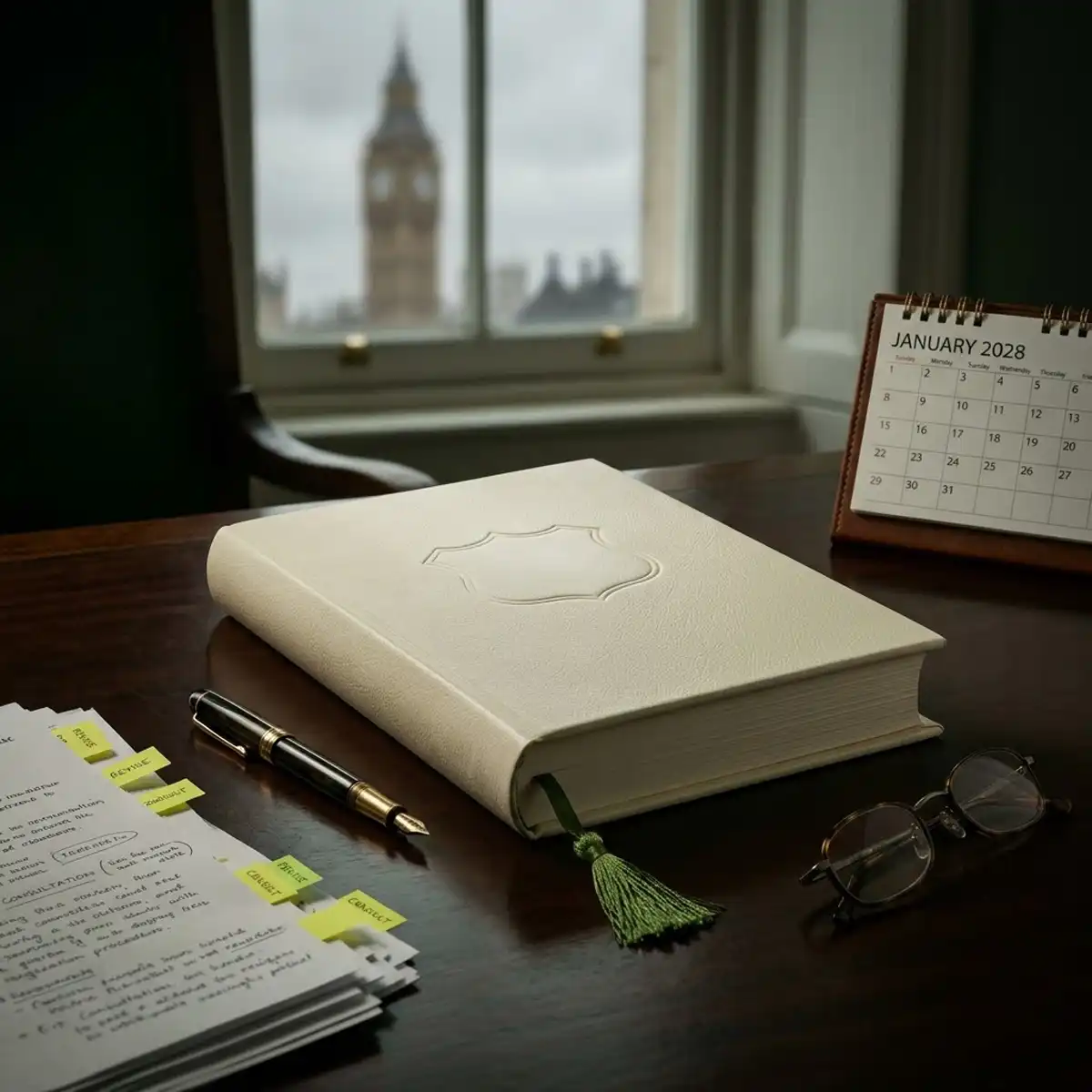
The BBC's current Royal Charter expires at midnight on 31 December 2027. The BBC Charter Review that will determine the replacement opened with the publication of the Green Paper Britain's Story: The Next Chapter on 16 December 2025, ran a 12-week public consultation that closed on 10 March 2026, and now moves toward a White Paper that Culture Secretary Lisa Nandy has indicated will be published later in 2026. The decisions made in the next several months will set the constitutional, financial, and editorial framework within which the BBC operates for the decade to 2038.
Three things about this Charter Review matter before the detail begins. First, the BBC arrived at the review at its weakest institutional moment in a decade. Director-General Tim Davie and BBC News Chief Executive Deborah Turness both resigned in November 2025 following a leaked memo from former Editorial Guidelines and Standards Committee adviser Michael Prescott, which raised concerns about the editing of a January 2021 Donald Trump speech in the Panorama documentary Trump: A Second Chance?. Second, the licence fee stood at £174.50 from 1 April 2025 and is CPI-linked through the end of the current Charter. Third, on 16 March 2026, six days after the public consultation closed, Lisa Nandy announced in a speech to the Society of Editors that the government intends to put the BBC on a permanent Charter, a significant constitutional change that was not itself part of the Green Paper.
What the Royal Charter actually is
The BBC's Royal Charter is the constitutional instrument that establishes the BBC as a public corporation and defines its mission, public purposes, governance structure, and funding basis. The current Charter was granted in 2016 and runs from 1 January 2017 to 31 December 2027. A Framework Agreement sits alongside the Charter and provides more detailed provisions on topics including editorial standards, the licence fee, and the relationship with Ofcom as independent regulator. Framework Agreement amendments agreed with the BBC and Ofcom, implementing the outstanding recommendations from the 2024 Mid-Term Review, were published in December 2025 alongside the Green Paper.
The Charter review process follows a defined path. A Green Paper sets out options and invites public consultation. A White Paper sets out the government's preferred policy direction. A draft new Charter is then published and debated in Parliament. The Privy Council formally grants the new Charter, which then takes effect on 1 January 2028. That sequence has been consistent across each renewal since the BBC's first Royal Charter in 1927, and the current review is the tenth.
The mechanics are worth stating because they shape what the review can and cannot change. A Charter cannot be amended to deliver outcomes the Framework Agreement could secure more easily. Editorial standards, impartiality rules, and complaints procedures sit largely in the Framework Agreement and in Ofcom's annual reporting. The Charter itself is the constitutional layer: what the BBC exists for, who appoints the Chair and the Board, how long the Charter runs, and how it is funded. The politics of the 2026 review cluster around precisely those four questions.
The licence fee and what the Green Paper proposes
The licence fee is the question with the most direct effect on households. Since 1946 the BBC has been funded primarily by an annual licence fee paid by households using equipment to watch or record programmes as they are broadcast, or to use BBC iPlayer. The fee stood at £174.50 from 1 April 2025. The Green Paper sets out four broad funding options for the post-2028 period.
The first is retention of the licence fee in its current form, potentially with reformed concessions, such as reviewing the over-75 concession currently linked to Pension Credit. The second is a hybrid model in which a reduced licence fee is supplemented by commercial revenue, potentially including advertising on specific BBC services or subscription tiers for premium content. The third is a universal household levy similar to the German Rundfunkbeitrag, which applies to every household regardless of whether its members watch the BBC. The fourth is a fundamental reform that could include general taxation or a ring-fenced funding settlement negotiated every several years.
DCMS has described the options as 'live' rather than preferred. The Green Paper does, however, acknowledge that the existing licence fee model is under structural pressure. Licence fee income has fallen in real terms over the past decade, the number of households paying has fallen in line with declining live-broadcast viewing, and enforcement relies on a combination of TV Licensing and, ultimately, criminal prosecution for non-payment. Independent analysis by the House of Commons Library has documented a decline in real-terms licence fee income and falling payer numbers in recent years, which is the underlying fiscal problem the Review must address.
What the BBC Charter Review actually decides
The BBC Charter Review decides the terms on which the BBC will operate from 1 January 2028 to the end of the next Charter period. It covers the BBC's mission, governance and board appointments, editorial framework, Charter duration, and funding model. The current licence fee is £174.50 per year, CPI-linked through 2027 under the existing Charter.
That definition is straightforward. The politics are not. The Charter review is a moment at which the relationship between the BBC and the government of the day is openly renegotiated, and the 2026 review is doing so in a context that includes a $5 billion defamation lawsuit filed by Donald Trump against the BBC in Florida on 16 December 2025 over the Panorama edit, the resignation of the Director-General, and an ongoing Society of Editors controversy over how reforms have been announced.
The permanent Charter proposal and why it is contested
On 16 March 2026, in a speech to the Society of Editors in London, Lisa Nandy announced the government's intention to place the BBC on a permanent Royal Charter. Under the current arrangement, if a new Charter is not agreed in time, the BBC technically ceases to exist when the existing Charter expires, a feature that the Green Paper itself acknowledged creates 'uncertainty' and an 'opportunity for political interference'.
The proposal has attracted measured support from some independent commentators, who argue that a permanent Charter aligned with the arrangements for the Bank of England and the British Film Institute, both of which operate under permanent Charters supplemented by primary legislation, would reduce the scope for political pressure at each renewal. It has also attracted sustained criticism. The Media Reform Coalition argued in March 2026 that a permanent Royal Charter on its own would not 'futureproof' the BBC against political interference unless it is paired with ending all government powers over Charter revisions, board appointments, and funding. The coalition also raised a process objection: the permanent Charter proposal did not feature in the Green Paper or the consultation survey, and announcing it in a speech to corporate media six days after the consultation closed, the coalition argued, repeated 'undemocratic practices' that blighted the 2014-15 Charter Review.
The process objection matters for the legitimacy of the review itself. DCMS described the charter renewal process as 'thorough, open and inclusive' on its December 2025 launch. Major constitutional reforms of the BBC announced in speeches rather than debated in the Green Paper sit uneasily with that description. How the White Paper addresses this will indicate whether the review outcome rests on consultation findings or on ministerial preference.
The governance question and the Robbie Gibb debate
Governance reform is the second constitutional thread of the review. Under the current Charter, the BBC Chair and Non-Executive Directors are appointed by the government through an Office of the Commissioner for Public Appointments (OCPA) process. Historically this has produced Chairs drawn from business, public service, and media. More recently, the appointment of Robbie Gibb, a former Conservative director of communications, to the Board attracted sustained criticism on the grounds that he was 'a political hire' in an institution whose independence depends on being seen to be apolitical.
The Green Paper explicitly invites views on the government's role in board appointments. Options being consulted on include a stronger independent element in the appointment process, devolved-nation representation with guaranteed seats, and a longer-term structure that outlasts the appointing government. The Charter does not itself make these changes; the Framework Agreement and the Public Bodies Order do. But the Charter is the instrument that sets the principle and the direction.
The underlying problem the governance reform is trying to solve is trust. Ofcom's Annual Report on the BBC 2024-2025, published on 28 November 2025, documented declining trust scores and a generational gap in BBC engagement, with the 16 to 34 age group using BBC services materially less than previous cohorts at the same age. Whether governance reform alone addresses that is a separate question and is not the Charter's to answer.
What the BBC is and what it generates
The scale of the institution at stake is worth recording precisely. The BBC adds approximately £5 billion in gross value added to the UK economy each year. It is the single biggest investor in UK-originated content, investing £1.2 billion in original UK content in 2023, equivalent to 23% of all investment in UK original content. It employs more than 20,000 people across production hubs in Belfast, Cardiff, Glasgow, Salford, and, from 2027, Digbeth. 94% of UK adults use BBC services on average every month, and it is the UK's most widely used news outlet.
These figures are DCMS baseline numbers and are not materially contested. What is contested is whether the distinctive British creative economy they support could be sustained under alternative funding structures, or whether, once the licence fee is replaced, the content investment pipeline that flows from it would contract. The BBC's own independent survey received 872,701 responses from account holders on the role of the BBC going forward, which is an unusually large engagement figure for a Charter-related consultation and indicates the level of public interest in the outcome.
Fun fact: The BBC has operated under 9 Royal Charters since its first Charter was granted on 20 December 1926. The first Charter established the BBC as a public corporation following two years of operation as a private company, the British Broadcasting Company Ltd. The Charter that follows the 2026 White Paper will be the 10th in the BBC's 102-year history, and if Lisa Nandy's proposal to place it on permanent footing is accepted, the last one ever granted under the existing renewal model.
Conclusion
The BBC Charter Review that opened in December 2025 will conclude with a new Charter that takes effect on 1 January 2028. Between now and then the government must publish a White Paper, lay a draft Charter before Parliament, and secure Privy Council approval. Four questions in particular will define the outcome. First, which of the four funding options in the Green Paper the White Paper endorses. Second, whether the permanent Charter proposal announced in March 2026 appears in the White Paper in the same form or is modified after the consultation analysis. Third, what governance reforms emerge from the board appointments debate. Fourth, how the Charter itself addresses the trust and generational engagement gap documented in Ofcom's annual report. The BBC Charter Review is ultimately a question about what role public service broadcasting plays in Britain in the 2030s. The licence fee and the institutional architecture are the instruments. What they are for is the decision Parliament will take.
Continue Reading
All articles →Newsletter
Stay updated on Digital News