On 14 January 2026, the UK Department for Energy Security and Net Zero announced the results of Allocation Round 7 of the UK Contracts for Difference scheme, awarding a record 8.4 gigawatts of offshore wind capacity at a clearing strike price of £91.20 per megawatt-hour. Four weeks later, on 10 February 2026, DESNZ announced the AR7a results for the remaining technologies, securing 6.2 gigawatts of onshore wind, solar, and tidal stream. Together, AR7 procured 14.7 gigawatts of renewable capacity across 201 projects, the largest single Contracts for Difference round in the scheme's twelve-year history. DESNZ described it as the biggest single procurement of offshore wind in British and European history.
The scheme is now the central financial mechanism through which the UK is trying to reach its Clean Power 2030 mission. National Energy System Operator modelling sets a target range of 43 to 51 gigawatts of offshore wind by 2030, against roughly 31 gigawatts installed or contracted today. AR7 has narrowed that gap; AR8, scheduled to begin later in 2026, will need to close most of what remains. Understanding how Contracts for Difference actually work is the first step in following the most important policy lever in UK electricity for the rest of the decade.
What a Contract for Difference actually does
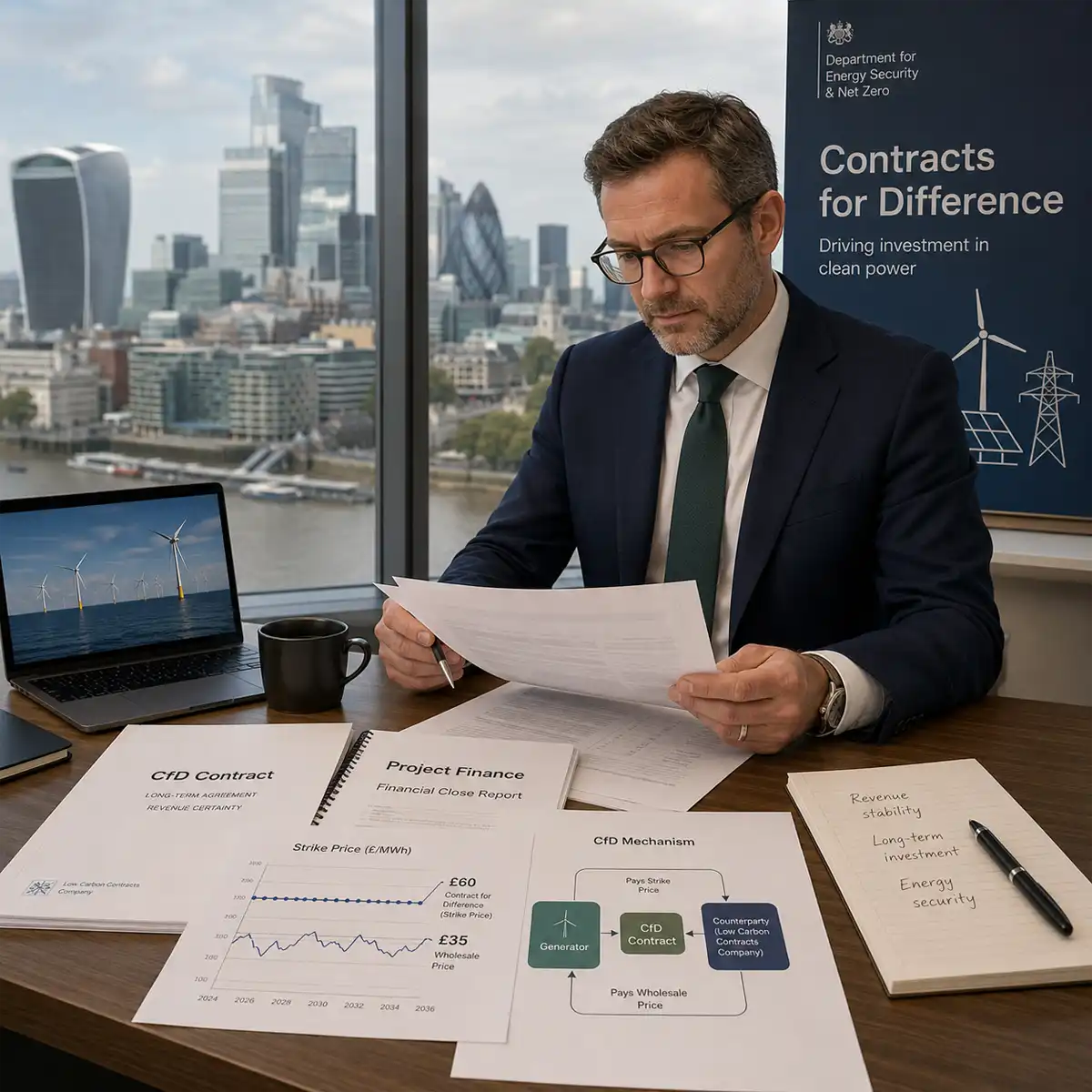
A Contract for Difference is a private-law contract between a low-carbon electricity generator and the Low Carbon Contracts Company, a state-owned counterparty. It guarantees the generator a fixed price for the electricity it produces, called the strike price. When wholesale prices are below the strike price, the LCCC tops up the generator's revenue. When wholesale prices are above it, the generator pays the difference back.
The mechanism is symmetric. In a high wholesale-price year like 2022, when gas prices spiked after Russia's invasion of Ukraine and UK wholesale electricity briefly exceeded £200 per megawatt-hour, CfD generators paid money back into the scheme, reducing levies on consumer bills. In a normal-price year like 2025, with average wholesale prices around £80 per megawatt-hour, generators received top-up payments where their strike prices were higher. The Energy and Climate Intelligence Unit estimates that wind generation reduced average wholesale UK electricity prices by around 31% across 2025, displacing the gas plants that set marginal prices most often.
The contract runs for twenty years under AR7, lengthened from the fifteen-year duration that applied in earlier rounds. The longer contract reduces the strike price required by giving generators more time to recover their capital costs. Payments are inflation-linked, indexed to the Consumer Price Index. The contract is private-law between the generator and the LCCC, but the LCCC's liabilities are ultimately recovered through final consumption levies on electricity supplier bills, which is how the cost of the scheme reaches consumers.
How the auction allocates the contracts
Contracts for Difference are allocated by reverse auction, called allocation rounds. Developers submit sealed competitive bids stating the strike price they need to make a project viable. The lowest-priced bids win contracts until the available budget or capacity cap is exhausted. The auction is administered by NESO, which acts as the Delivery Body under the Contract Allocation Framework published before each round. AR7 used a framework dated 23 July 2025.
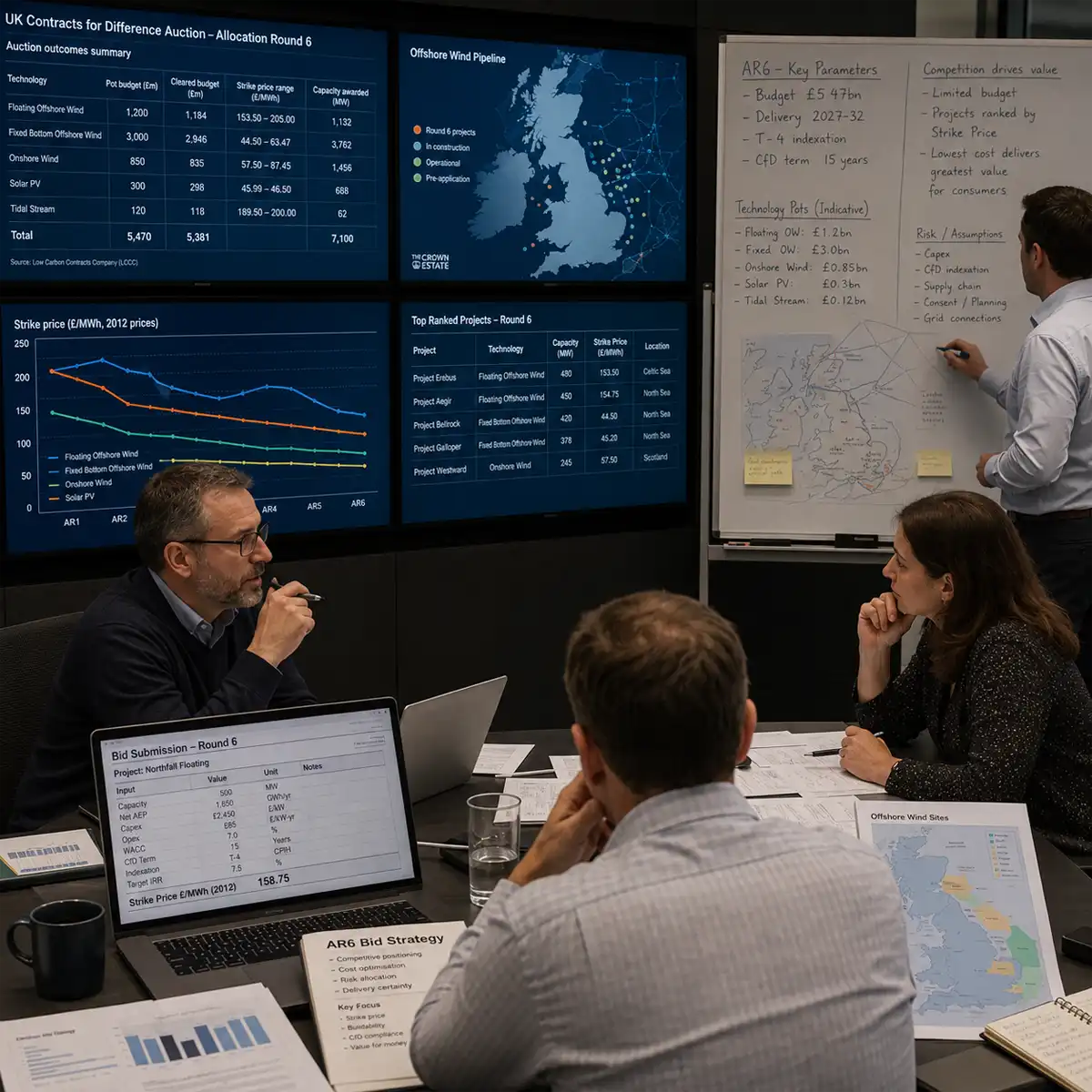
Technologies are grouped into separate pots so that mature and less mature technologies do not compete head-to-head. In AR7, Pot 1 covered established technologies including onshore wind and solar, Pot 2 covered less established technologies including tidal stream, Pot 3 covered fixed-bottom offshore wind, and Pot 4 covered floating offshore wind. The split prevents a situation in which cheap solar would systematically displace floating offshore wind, which is still at an earlier point on its cost-reduction curve. The administrative strike price cap, the maximum at which a technology can clear, sits well above expected clearing prices for mature technologies and closer to expected clearing for emerging ones.
AR7 was also the first round to run as two separate auctions. The offshore wind auction ran in November 2025 with results in January 2026; the auction for all other technologies ran in early 2026 with results in February. The split was designed to let offshore wind developers progress critical projects without being delayed by the longer auction cycle for other technologies. AR7's offshore wind budget started at £900 million but was increased to £1.79 billion during the round to accommodate the level of competitive bidding. The decision to increase the budget mid-round was unusual; the result was a clearing price of £91.20 per megawatt-hour, well below the administrative strike price cap of £113 per megawatt-hour and substantially below the £147 per megawatt-hour cost estimate for new gas generation.
How the AR7 strike prices compare to alternatives
The headline AR7 strike prices in 2024 prices are: solar at £65 per megawatt-hour (6.5% lower than AR6), onshore wind at £72 per megawatt-hour (2% higher than AR6), fixed offshore wind at £91.20 per megawatt-hour (above AR6's £77.50), and Scottish fixed offshore wind at £89.94 per megawatt-hour. Floating offshore wind cleared below its £271 per megawatt-hour administrative cap. The 2024-price convention replaced the older 2012-price convention from AR7 onward, which is why direct numerical comparison to early-round strike prices requires inflation adjustment.
The offshore wind clearing price has risen across AR5, AR6, and AR7, reflecting genuine cost pressures: turbine and steel prices rose more than 40% across 2022 to 2024, supply chain capacity is tight as global offshore wind deployment scales, and financing costs are higher than they were during the lowest-priced earlier rounds. Independent analysis from Aurora Energy Research and Baringa has indicated that strike prices below approximately £94 per megawatt-hour would reduce bill-payer costs compared with continued gas generation; AR7's £91.20 sits within that threshold. The point is not that offshore wind is now cheaper than it was; it is that offshore wind is still cheaper than the gas alternative it is replacing, even at the higher 2026 strike prices.
The full operational picture covers 47 gigawatts of renewable capacity contracted across all rounds since 2014, of which 10 gigawatts is operational and producing power as of late 2025, with roughly 40 gigawatts in development. CfD-contracted projects generated enough electricity in the year to October 2025 to power 13 million UK homes, about half the total housing stock. The next round, AR8, will need to procure roughly 12 gigawatts more offshore wind capacity to keep the Clean Power 2030 target within reach.
Why AR5 in 2023 is the cautionary tale
Allocation Round 5, held in 2023, is the reference point against which subsequent rounds have been calibrated. AR5 set an administrative strike price cap of £44 per megawatt-hour for fixed offshore wind, against a backdrop of turbine cost inflation of over 40% and rising financing costs. No offshore wind developer bid into AR5. The round instead allocated 3.7 gigawatts of capacity across solar, onshore wind, and a small geothermal project, with the offshore wind capacity that the UK had assumed it would procure not delivered at all.
The lesson of AR5 was that auction parameters are not abstract policy levers. If the administrative cap is set below commercial viability, the result is not lower prices but no procurement at all, and the time lost cannot be recovered from a subsequent round running on the same calendar. AR6 in 2024 corrected the cap upward and procured 3.7 gigawatts of offshore wind at a £77.50 per megawatt-hour clearing price. AR7's success in 2026 has built on the calibration approach AR6 established. Whether AR8 can sustain the cost trajectory while continuing to scale capacity is the question DESNZ will need to answer in the budget and parameters it publishes later this year.
How the Clean Industry Bonus and other AR7 reforms work
AR7 introduced or extended several mechanisms designed to improve scheme performance. The Clean Industry Bonus, launched in November 2024 under the name Sustainable Industry Rewards and subsequently renamed, provides additional CfD support to offshore wind projects that invest in more sustainable UK supply chains. It is allocated competitively, with a budget of £27 million per gigawatt of capacity awarded under AR7. Applications were assessed during 2025 alongside the main auction. The mechanism is designed to direct procurement spending toward UK industrial supply chain capacity, not simply lowest-cost generation.
Three further reforms applied from AR7. Contract length increased to twenty years for wind and solar, up from fifteen. Fixed offshore wind bids were accepted without full planning consent, provided a Development Consent Order application had been accepted at least twelve months before the auction. Onshore wind projects became eligible for re-powering with new turbines once original turbines reached twenty-five years of operation. Each of these changes makes the underlying economics work harder for developers, which is reflected in the competitive AR7 clearing.
Floating offshore wind received its own dedicated pot for the first time. The technology, in which turbines are mounted on floating platforms rather than fixed monopile foundations, allows wind farms in waters too deep for fixed-bottom installation, opening the Celtic Sea and other deeper UK sites. Floating offshore wind's strike price ceiling at £271 per megawatt-hour reflects the earlier stage of the cost-reduction curve. The Erebus project in the Celtic Sea, at 100 megawatts, is among the early floating-wind projects benefiting from this allocation framework. Whether floating offshore wind reaches commercial viability comparable to fixed-bottom installations over the next decade will shape the upper end of the UK's offshore wind potential.
Where the scheme remains contested
Three policy debates sit on contested ground. The first concerns the cost of the scheme to consumer bills. The Renewable Energy Foundation and several free-market think tanks argue that CfD payments add a measurable cost to electricity bills and that scheme costs should be tracked transparently against gas-counterfactual savings. The Energy and Climate Intelligence Unit, Energy UK, and the Energy Saving Trust counter that the wholesale price suppression from wind generation produces net savings that exceed CfD payments, and that the headline 'levy cost' on bills understates the broader benefit. Both positions can be supported with named source material; the methodology dispute is genuine.
The second debate is on supply chain. The Clean Industry Bonus is the policy response to the concern that the UK risks procuring offshore wind capacity built almost entirely with imported manufacturing. The Offshore Wind Industry Council and named UK manufacturers have argued for stronger domestic content requirements. International developers counter that explicit content rules would breach the UK's World Trade Organization commitments and could push costs higher than the savings from domestic capture justify. The Clean Industry Bonus is a compromise between these positions; whether it produces material UK manufacturing investment remains to be seen across AR8 and beyond.
The third debate is on the relationship between Contracts for Difference and dispatchable low-carbon capacity. CfD has been built around intermittent renewable generation. The UK system also needs dispatchable low-carbon capacity, currently filled by nuclear, with biomass and hydrogen-to-power expected to take partial roles. New nuclear projects including Hinkley Point C and Sizewell C use a different commercial mechanism, the Regulated Asset Base model, rather than CfD. Whether the Clean Power 2030 system can be balanced with the current mix of CfD intermittent generation and slow-scaling dispatchable capacity is the deeper engineering question underneath the auction cycle.
Fun fact: The first ever Contracts for Difference auction in October 2014 awarded 2.1 gigawatts of capacity, including two early offshore wind projects, East Anglia One at 714 megawatts and Neart na Gaoithe at 448 megawatts. The 2026 AR7 round procured nearly seven times that capacity in a single auction.
What to watch in the next twelve months
Three specific things will shape the next phase of UK Contracts for Difference. The AR8 budget and administrative strike price caps will be published by DESNZ later in 2026, and will set the conditions under which the next round can deliver the roughly twelve gigawatts of additional offshore wind the Clean Power 2030 target requires. The first AR7-contracted offshore wind projects will reach financial close and begin construction across 2027 and 2028, which is when the procurement decisions made in January 2026 begin to translate into operational capacity. Floating offshore wind's commercial trajectory, particularly the Celtic Sea projects, will indicate whether the technology can move from its current premium pricing toward parity with fixed-bottom installations over the next decade. The auction cycle has set the direction; the delivery cycle will decide whether the direction holds.
Continue Reading
All articles →Newsletter
Stay updated on Digital News