Britain's independent jewellery retailers are quietly resolving a problem that has constrained them for two decades. They can now show customers hundreds of thousands of certificated diamonds on their own websites without owning a single one of them. The mechanism is a wholesale marketplace connected to a retail storefront by off-the-shelf software, and the shift it represents is meaningful.
For most of the online era, the ability to sell diamonds online at scale belonged to a handful of well-funded international brands, because the software required to do it cost more than an independent jeweller's annual profit.
That barrier has fallen, and the consequences are showing up in high streets from Hatton Garden to Harrogate. The shift has attracted little coverage, partly because it involves no new consumer product and no funding announcement. It is simply a change in what a piece of retail software costs, and it has redistributed a competitive advantage that stood unchallenged for the better part of 15 years.
What Has Actually Changed in Diamond Retail
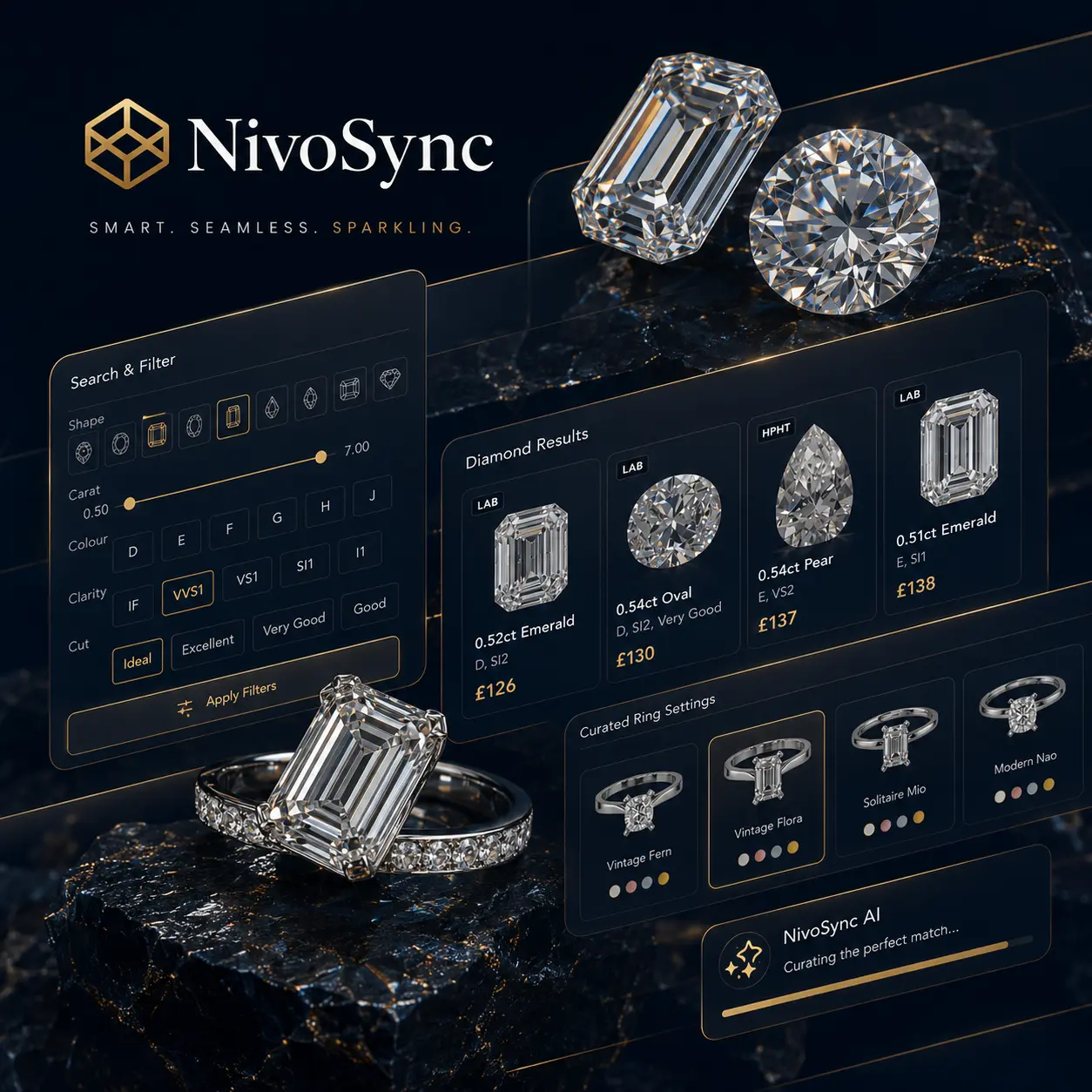
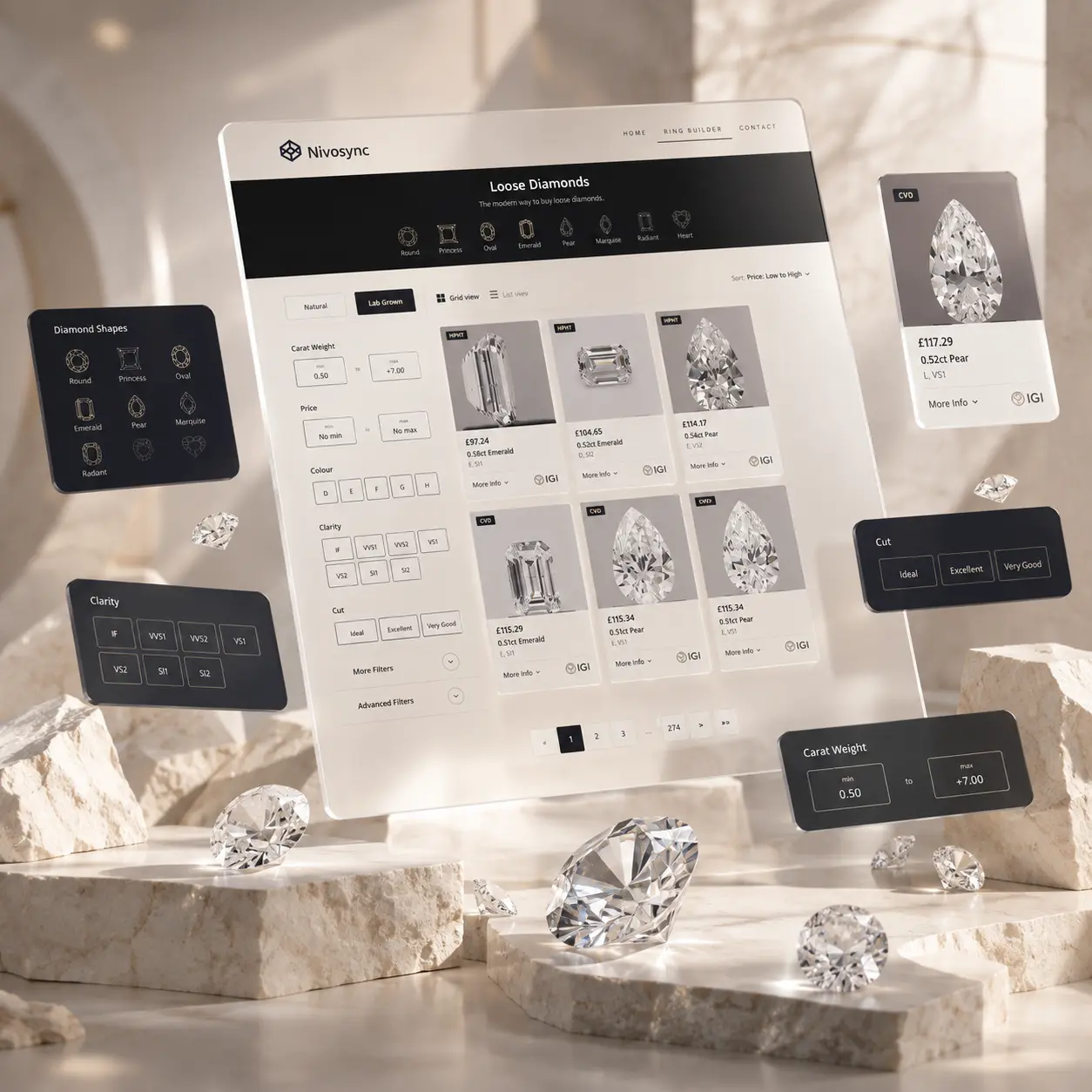
The change is one of access rather than invention. Wholesale diamond marketplaces have aggregated supplier inventory for years, letting retailers search stock held by independent suppliers in India, Belgium, Israel and Hong Kong. What is new is that this inventory now appears directly on independent retailers' own websites, priced with their margin and bought through their own checkout.
Previously that inventory was visible only on a trade terminal in a back office. A customer asking about a 1.20ct cushion cut would be read a list of options over a counter. The marketplace stock existed but was invisible to the public, which meant the independent's website showed 40 rings while a funded competitor's showed 60,000.
The gap was not one of expertise. Independents generally know their product considerably better than a call centre does. It was purely a software gap, and it decided a great deal of market share over the past decade.
Why the Cost Barrier Collapsed
Connecting a wholesale marketplace to a retail website is a genuine engineering project, and until recently it was priced like one. Agencies have routinely quoted between £15,000 and £40,000 for the integration alone, with full custom catalogue builds costed at around £50,000 across 18 months.
Those figures cover version one only. The recurring burden is what made the model unworkable for small retailers. Upstream interfaces change, ecommerce platforms ship major releases, pricing rules accumulate exceptions, and a sync that fails silently leaves a shop advertising stones that sold a week ago. Maintaining a bespoke integration is an ongoing engineering commitment, not a one-off purchase.
Packaged plugin software has replaced that with a licence. Products such as nivosync.com bundle the marketplace sync, local caching, pricing engine, filtering and checkout into a single installation for an annual fee, with launch pricing at £899 per year against a standard £1,499 excluding VAT. Against a £15,000 build plus a developer on retainer, the comparison resolves itself for any retailer turning over under seven figures online.
How the Model Works From the Customer's Side
A customer browsing an independent jeweller's diamond catalogue is looking at stones held by suppliers overseas, listed with the retailer's own price. When the customer buys, the retailer orders that specific stone, has it delivered to the UK, and sets it in the chosen mount.
The customer's contract is with the retailer throughout, which means consumer protections apply in the ordinary way. The Consumer Rights Act 2015 covers goods that arrive faulty or not as described, and misdescription includes a stone that does not match its grading certificate. Distance selling rules provide a 14-day cooling-off period on standard online purchases, though rings made to a customer's specification are generally treated as bespoke and excluded from automatic return rights.
One operational detail carries real consumer significance. Diamonds above roughly half a carat are individually unique, so the same physical stone can be listed by several retailers simultaneously. Competent implementations place an automatic hold on the specific stone with the supplier at checkout and release it if the order is cancelled. Systems that skip this step can and do sell the same diamond twice.
Fun fact: The Gemological Institute of America introduced the 4Cs grading framework and the modern diamond grading report in the 1950s, creating the first common language that allowed diamonds to be traded on described characteristics rather than on inspection alone.
Who Stands to Lose From the Shift
The pressure falls on two groups. The first is the mid-market online-only retailer whose principal advantage was inventory breadth rather than product knowledge or brand. When every independent with a website can show comparable selection, breadth stops being a moat.
The second is the agency sector that built these integrations as bespoke commissions. A £20,000 project that becomes a £899 licence is not a market that shrinks gradually. Some agencies have moved to implementation and merchandising work around packaged products, which is a smaller but more durable business.
Traditional wholesalers and dealers occupy a more ambiguous position. Marketplace aggregation has compressed intermediary margins across the trade, and the retailers now buying through these platforms are frequently the same businesses that once relied on a local dealer arriving with a parcel of stones. That relationship has not disappeared, but it has thinned.
What Being Able to Sell Diamonds Online Means for High Street Jewellers
The clearest beneficiary is the established independent with a physical shop and genuine expertise. Selection was the one dimension on which they could not compete, and it has been neutralised.
What remains as differentiation is precisely what a website cannot replicate. Setting design and workshop quality, the judgement to match a stone to a mount, the ability to show a customer two diamonds side by side under consistent light, and aftercare including resizing, replating, valuation and setting checks. Those are the reasons a buyer travels to a shop, and they have become more commercially important rather than less.
The counter-risk is real and worth stating. A retailer who installs a catalogue and treats it as a finished job will find it converts poorly. A grid of 50,000 stones is a research tool, and the businesses seeing genuine revenue pair it with a guided ring configurator, invest properly in photography of their own settings, and use the catalogue as the front door to a consultation rather than as a substitute for one. The technical and commercial considerations are set out in detail in Teksyte's assessment of connecting wholesale diamond inventory to a WordPress store.
What Buyers Should Take From This
Buyers should treat the arrival of large diamond catalogues on independent websites as an advantage, provided they ask a few direct questions. Confirm the grading laboratory and certificate number, and verify that number on the laboratory's own website rather than relying on the retailer's copy of it.
Establish whether the displayed price includes the setting and VAT or refers to the loose stone alone. Ask whether you can view the stone before final payment and at whose cost if you decline it. Ask what happens to your stone between payment and dispatch, because the answer distinguishes a properly connected system from a spreadsheet. And confirm in writing whether your order counts as bespoke, since that determines your return rights.
Check the hallmark position as well. UK law requires precious metal articles above the statutory weight thresholds to carry an Assay Office hallmark, and this applies regardless of where the stone was sourced.
Where This Goes Next
The direction of travel is towards inventory ceasing to be a competitive asset in diamond retail altogether. When every retailer can display the same stones at similar speed, the differentiators become merchandising, photography, configurator design, consultation quality and aftercare.
That is a healthier basis for competition than capital depth, and it favours the retailers with actual product knowledge over those with the largest marketing budget. It also raises the floor on what customers should expect from a jeweller's website, which will not be comfortable for retailers who have treated their site as a brochure.
For an industry that has been slow to digitise and quick to blame consumers for shopping online, the ability to sell diamonds online without a five-figure software project is an unusually straightforward piece of good news. Whether independents use it well is now a question of merchandising rather than of budget. Further context on how directory visibility and online presence drive independent retail growth is covered in our analysis of why directory listings matter for business growth, and the district-level picture appears in our overview of Hatton Garden as London's jewellery hub.
Continue Reading
All articles →Newsletter
Stay updated on Digital News