The government has no plans to change the law that keeps the Elgin Marbles in the British Museum, a minister told the House of Lords on 3 November 2026. Baroness Twycross, answering for the Department for Culture, Media and Sport, said the government had made no assessment of proposals for a permanent return to Greece and that the British Museum Act was not in the King's Speech.
The answer closes one door that campaigners had hoped was ajar. A newer legal route, the "moral obligation" power in the Charities Act 2022, came into force in November 2025, but the order that switched it on excluded the British Museum's collections by name. That leaves a loan as the only arrangement either government is discussing, and the British Museum's stated condition for a loan, that Greece acknowledges its ownership, is the condition Athens has always refused.
Ministers will not change the 1963 Act, and the 2025 order switching on the moral obligation power excluded the British Museum's collections. The sections below set out what the 3 November exchange, the 1963 Act and the 2025 commencement order actually say, and what would have to change for the sculptures to leave London permanently.
What the minister told the Lords on 3 November
The question came from the Earl of Clancarty, a crossbench peer, who asked what assessment the government had made of proposals for the permanent return of the Parthenon sculptures to Greece. According to the official Hansard record of the exchange, Baroness Twycross replied that the government "have made no assessment" and welcomed the fact that the museum was in discussions with Greek ministers, "seeking a constructive partnership".
Lord Clancarty pressed the point that the museum's hands are tied by its own statute and asked whether ministers would amend the Act in a limited way. Baroness Chakrabarti, from the government's own benches, asked the same question more bluntly. The minister's answer to her was the clearest line of the session: "We have no plans to review the British Museum Act. It was not in the King's Speech."
Later in the same exchange, answering the Green peer Baroness Jones of Moulsecoomb, Baroness Twycross repeated that the government "do not have any plans to change the law or introduce legislation to permit the Parthenon sculptures to be returned permanently", while saying it supported the museum's willingness to consider a loan request. Lord Addington, for the Liberal Democrats, asked whether any legislation needed for a future deal would be passed within this Parliament. The minister said there was "no agreement for us to lean into in that way" at present.
The name matters in this story. Parliament, the museum and the Greek government use "Parthenon sculptures" or "Parthenon marbles". The Elgin Marbles, after Thomas Bruce, 7th Earl of Elgin, whose agents removed them from Athens in the early 19th century, is the older British name and the one most people in the UK still search for.
Can the British Museum legally give the Elgin Marbles back
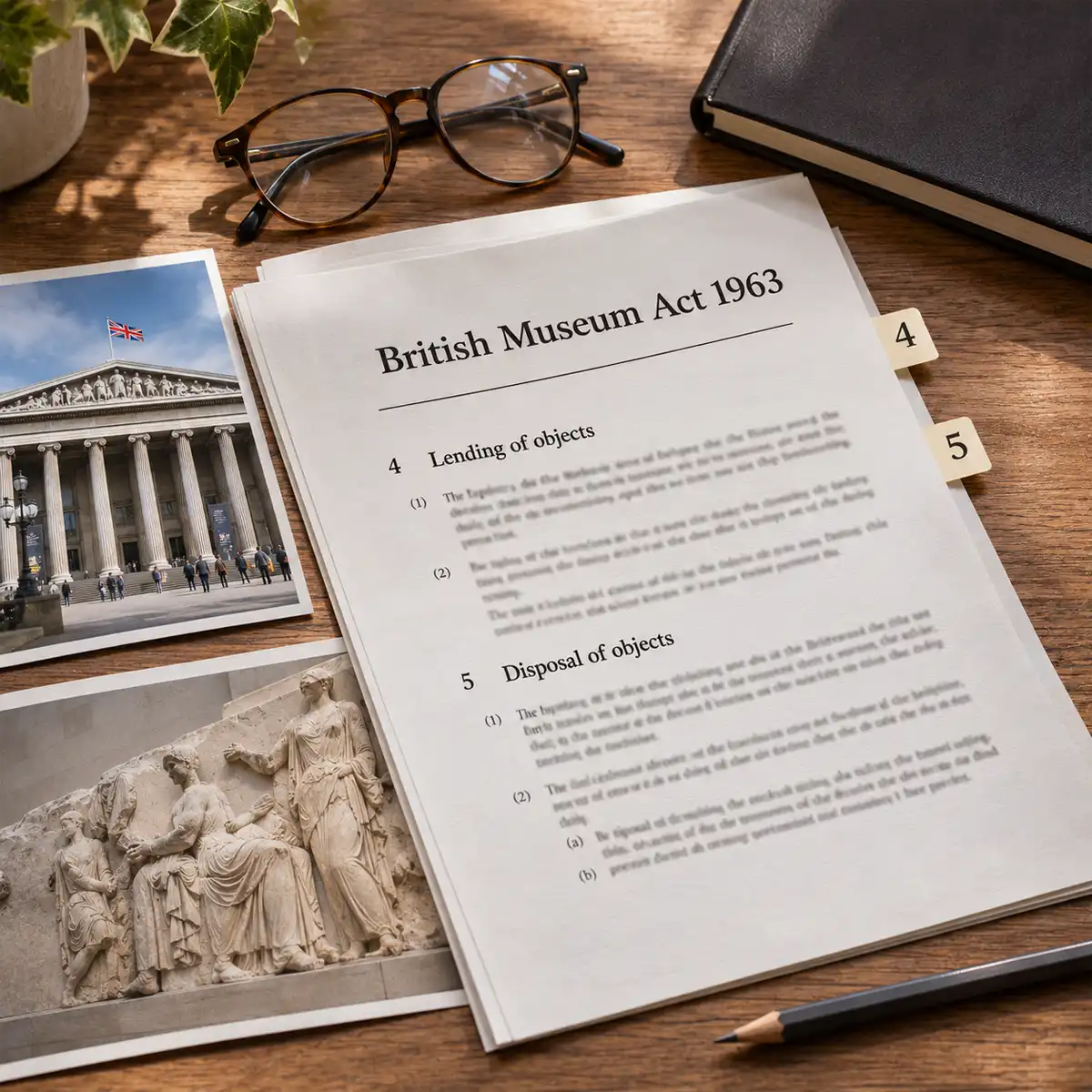
No, not as a permanent transfer under the law as it stands. Section 5 of the British Museum Act 1963 lets the trustees sell, exchange or give away an object only if it is a duplicate, a post-1850 printed item they hold a photographic copy of, or unfit to be retained and removable without detriment to the interests of students.
A second limb allows the trustees to destroy or dispose of objects that have become useless through damage, physical deterioration or infestation. None of the limbs describes a set of 5th century BC sculptures from the Parthenon, which is why the argument keeps returning to Parliament rather than to the museum's board.
Lord Dubs asked the minister directly whether section 5(1)(c), the "unfit to be retained" limb, would be enough to return the Elgin Marbles without new legislation. She did not say that it would. Her answer listed the exceptions instead: duplicates, objects not fit for retention, and 2 categories Parliament has carved out separately.
Those 2 carve-outs show what a change would look like when Parliament does want one. The Holocaust (Return of Cultural Objects) Act 2009 lets named national museums transfer an object taken during the Nazi era, but only after the Spoliation Advisory Panel recommends it and the Secretary of State approves. Its original sunset clause was removed by an amending Act in 2019.
Section 47 of the Human Tissue Act 2004 lets the same museums transfer human remains of a person who died less than 1,000 years before the section came into force.
Each was a specific Act of Parliament for a specific class of object. There is no equivalent for antiquities in general, and none for the Elgin Marbles.
The moral obligation route that was switched off
The newest legal argument rests on the Charities Act 2022, and the government's own commencement order is where it stops. The British Museum is a charity. Section 16 of the Charities Act 2022 rewrote the power for the Charity Commission, the Attorney General or a court to authorise trustees to give property away where they "could reasonably be regarded as being under a moral obligation" to do so. Section 15 added a smaller power trustees can use alone, capped at £20,000 for charities with income over £1 million.
The wording that drew campaigners' attention is subsection 1A, which says the power is "not disapplied only because" a charity's founding legislation prohibits giving property away. Read alone, that looks like a way round the 1963 Act.
Subsection 1A does not stand alone. The Charities Act 2022 (Commencement No. 4 and Saving Provision) Regulations 2025, signed by the culture minister Stephanie Peacock on 14 November 2025, brought sections 15 and 16 into force on 27 November 2025 "except in so far as they relate to excluded property of a relevant charity". The schedule then lists the relevant charities. The Trustees of the British Museum are on it, and the excluded property is described as "objects vested in the Trustees of the British Museum as part of the collections of the Museum".
The same schedule excludes the collections of the Imperial War Museum, the Natural History Museum, the National Gallery, the National Portrait Gallery, the National Maritime Museum, the Museum of London, the Royal Armouries, National Museums Liverpool and the Royal Botanic Gardens, Kew, among others. For the national collections, the moral obligation power exists in the statute book but has not been switched on.
That is the point Lord Clancarty appeared to be reaching for. Baroness Twycross told him that DCMS has committed to review the implementation of sections 15 and 16 as part of the post-implementation review of the whole Act, and that the review "is due to report in February 2027". If the exclusion were lifted for the British Museum, the trustees could in principle apply to the Charity Commission to return the Elgin Marbles on moral obligation grounds without a new Act of Parliament. Nothing in the 3 November answers suggests ministers intend to lift it.
Why a loan is the only deal on the table
A loan of the Elgin Marbles is the only arrangement both sides are discussing because it needs no change in the law. According to the minister, the British Museum "has consistently stated that it would consider a loan request" on condition that its ownership is acknowledged and that a binding undertaking is given to return the sculptures.
The Greek government's position has run the other way. At the Dialogues for Athens conference on 6 October 2026, the Greek prime minister, Kyriakos Mitsotakis, said the sculptures would be part of a wider UK and EU discussion, GTP Headlines reported; he told the audience the question belonged to Europe as a whole as well as to Greece. The same report says he described the sculptures as stolen and acknowledged that a deal would need an exception to the legal framework governing the museum, which in turn needs a majority in the UK Parliament.
The minister pointed to a model. She told peers the museum's director had alluded to the Bayeux loan, the 11th century embroidery France has lent to Britain, as a potential model, and described that loan as "proving a huge success story". Lord Ricketts, a crossbench peer, said the embroidery had drawn more than 200,000 visitors and asked for an assurance it would go back to France. Baroness Twycross gave one, saying there was no intention of keeping it in this country.
Context: The Bayeux loan was cited in the Lords as the template, and the minister described it as the first time the embroidery had come to the UK in more than 900 years (Hansard, 3 November 2026).
The comparison carries the sticking point inside it. France lent the embroidery and keeps ownership of it, which is exactly the condition the British Museum attaches to the Elgin Marbles and exactly the condition Greece declines, because accepting a loan of objects it considers its own would concede the ownership it disputes.
The case for leaving the law alone
Peers opposed to a return made their case in the same session, and it is the strongest argument the government has for doing nothing. Viscount Hailsham, a Conservative, said that given how many objects in British museums were acquired abroad "frequently in rather doubtful circumstances", returning the sculptures "will be a most unfortunate precedent". The Earl of Effingham, also a Conservative, said more than 6 million people a year view the Elgin Marbles and that the museum's stance was clear.
The precedent argument has weight beyond the Parthenon. Later in the session Lord Sahota raised the Koh-i-noor diamond, which he said was taken from the 10-year-old Maharaja Duleep Singh after Britain annexed the Sikh Empire in 1849, and asked whether it would be returned. The minister said it remained the government's long-standing position that the diamond stays in the UK. A general power to return objects on moral grounds would apply across every national collection, not to one object. The 2025 order excludes those collections as a class and gives no reason in its text.
Those who favour return argued the opposite. Baroness Hussein-Ece said a museum had been purpose-built near the Parthenon, a reference to the Acropolis Museum in Athens, which opened on 20 June 2009, and that the British Museum holds far more than it displays. Baroness Jones of Moulsecoomb said there were gaps on the Parthenon "where the sculptures ought to fit back".
Both cases were heard. The government's answer to both was the same: museums are independent of government, the decision is the museum's, and the museum's legal powers will not be widened.
What would have to change
There are 2 legal routes to a permanent return of the Elgin Marbles, and both need ministers. The first is a new Act, or an amendment to the 1963 Act, creating a specific power to transfer the sculptures, as Parliament did for Nazi-era spoliation in 2009. That needs a Bill to pass both Houses, which is why it matters that the minister said the Act was not in the King's Speech. Our explainer on how a Bill becomes an Act in the UK Parliament sets out the stages a government Bill would have to clear.
The second is secondary legislation: a further commencement order removing the British Museum's collections from the exclusion in the 2025 regulations, after which the trustees could ask the Charity Commission to authorise a transfer on moral obligation grounds. That would not need a new Act, but it would need a minister to sign the order and the trustees to want to apply.
Neither route is under way. The first fixed date is February 2027, when the post-implementation review of the Charities Act 2022 is due to report. Whether it says anything about the excluded national collections is the question to watch. Until then the realistic outcome is the one both governments describe: talks about a loan, conditional on an acknowledgement of ownership that Greece has so far refused to give.
Continue Reading
All articles →Newsletter
Stay updated on Digital News