Mandatory UK Biodiversity Net Gain became law for major planning applications in England on 12 February 2024 and for small sites on 2 April 2024. Two years on, the policy has moved from an initial compliance curve to a measurable evidence base. Defra estimates that the regime is preventing between 6,000 and 10,000 hectares of habitat loss annually, an area roughly the size of Nottingham, and is reshaping the point in development design at which biodiversity is considered. On 20 April 2026, Defra published a package of policy updates on the BNG regime that will reshape implementation through late 2026 into 2027.
This article sets out how the regime actually works in practice, what the evidence on delivery and compliance shows after 24 months of operation, what the April 2026 update changes, and where the unresolved scientific and enforcement questions now sit. The honest short answer to the two-year retrospective question is that BNG is working in parts, showing measurable design-stage effects, but that questions about enforcement capacity and long-term habitat delivery will not be answerable until the first significant cohort of sites is built out and monitored, which is three to five years away.
How the regime actually works
BNG was introduced by the Environment Act 2021, which inserted Schedule 7A into the Town and Country Planning Act 1990 via Schedule 14 of the 2021 Act. The core obligation is that most development in England must deliver a measurable net increase in biodiversity value of at least 10% compared to the pre-development baseline, secured for a minimum of 30 years through a planning condition, a Section 106 agreement, or a conservation covenant.
Biodiversity is measured using the Defra statutory biodiversity metric, currently version 4.1. The metric converts habitat areas, hedgerows, and watercourses into standardised 'biodiversity units' based on four factors: habitat size, distinctiveness, condition, and strategic significance. A biodiversity gain plan must demonstrate how the 10% uplift will be delivered, in order of preference: on-site habitat creation or enhancement, off-site delivery on registered BNG sites, and, as a last resort, the purchase of statutory credits from the government. Natural England operates a national biodiversity gain sites register for off-site delivery, publicly searchable at gov.uk.
Three features of the regime are worth stating precisely because they are where delivery succeeds or fails. First, the metric is a scientific instrument, not a policy instrument: it requires ecological surveying to a defined standard and the interpretation of habitat distinctiveness bands against published guidance. Second, the 30-year management obligation is the longest landscape commitment a developer takes on in the English planning system. Third, the mitigation hierarchy of avoid, mitigate, compensate remains in force and sits above BNG; BNG is an additional net positive obligation, not a replacement for existing habitat protection.
What UK Biodiversity Net Gain requires in practice
UK Biodiversity Net Gain requires most English planning applications to deliver a measurable 10% increase in biodiversity value, calculated using the Defra statutory biodiversity metric 4.1. Developers deliver gains on-site, off-site through registered BNG sites, or as a last resort via statutory biodiversity credits. Habitats must be secured for a minimum of 30 years.
That operational definition is deliberately concise because the detail sits in the Defra metric, in Natural England's guidance, and in secondary legislation. What gets measured and how it is counted determines whether the regime delivers real biodiversity or accounting biodiversity, which is the central scientific question the two-year evidence base is now beginning to answer.
What the two-year evidence actually shows
Two years of operation produces three reasonably firm findings and several that remain open. The first firm finding is that BNG is influencing design-stage decisions. Developers are integrating biodiversity into site selection and master planning earlier, rather than treating it as a late-stage compliance exercise. The government's April 2026 update cites reduced rates of late redesign and earlier coordination between landscape architects, ecologists, and planning consultants as the clearest design-stage effect of the regime to date.
The second firm finding is on aggregate land-use effect. Defra's working estimate that BNG prevents between 6,000 and 10,000 hectares of habitat loss annually is derived from the combination of baseline habitat protection in the pre-development metric score and the 10% uplift on top. That range is consistent with independent modelling work by the Joint Nature Conservation Committee and with the 2024 National Audit Office report on BNG implementation. The uncertainty band reflects variation in how small sites, brownfield sites, and linear developments are counted.
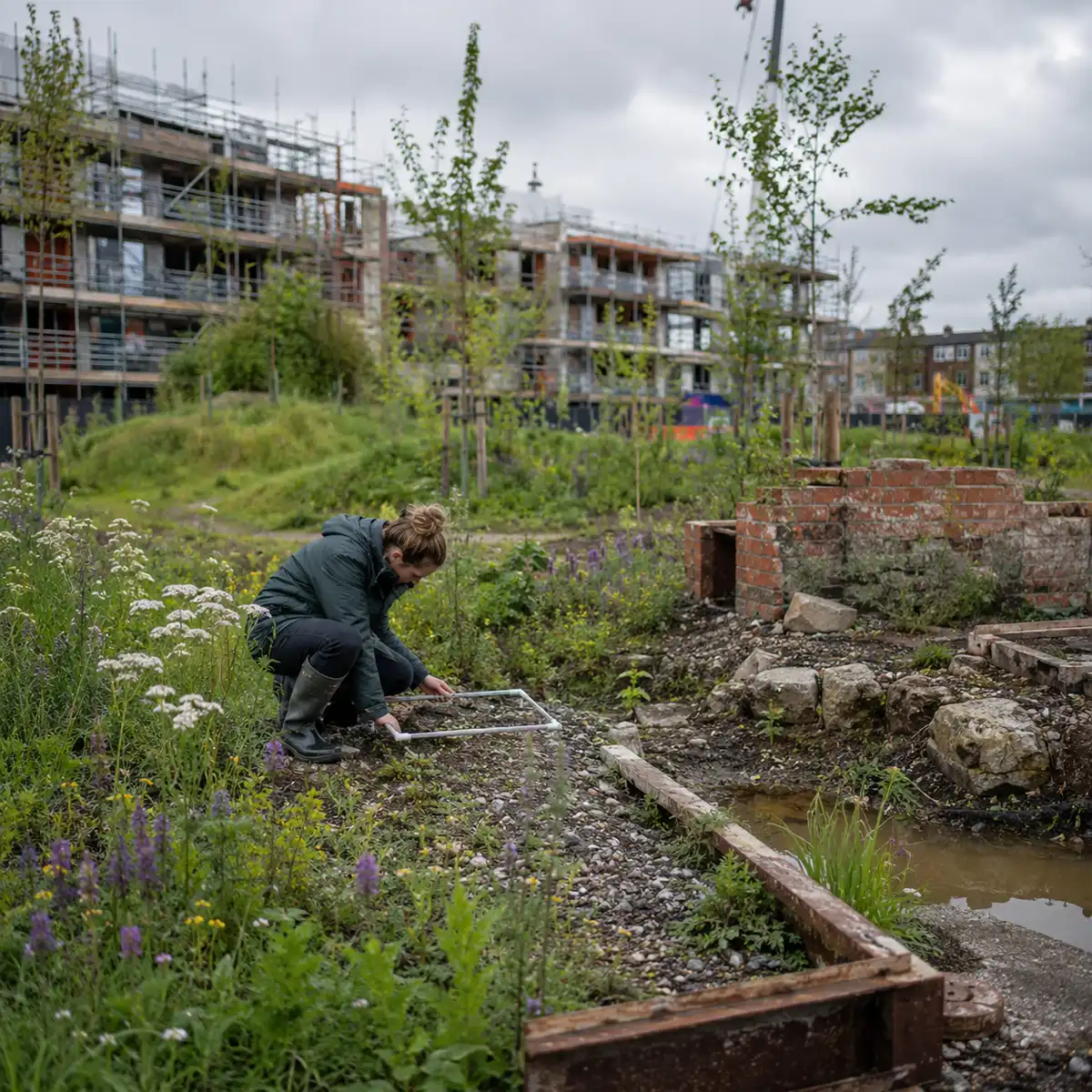
The third firm finding is on individual project outcomes where BNG has been delivered well. The Broad Marsh redevelopment in Nottingham, carried out by Willmott Dixon, achieved a 438% biodiversity net gain on an urban brownfield baseline. That figure is unusual because urban baselines are often very low, meaning modest habitat creation produces large percentage increases, but it is not meaningless: it demonstrates that well-designed urban schemes can generate substantive habitat outcomes rather than nominal ones. Similar outcomes have been documented on major transport and energy infrastructure sites where BNG has been delivered at scale.
Two findings remain open. The first is on the quality of habitat creation in practice, as distinct from the metric-calculated score at consent. The regime assumes that habitat created under BNG will achieve the condition state projected in the biodiversity gain plan within the 30-year management period. That assumption will not be testable until the first significant cohort of BNG sites is built out and monitored, which will be the second half of the 2020s at earliest. The second open finding is on the balance between on-site and off-site delivery. Academic researchers including those at the University of Oxford and the University of Kent have noted that the majority of projected habitat creation is occurring on development sites themselves, which may not produce optimal outcomes for landscape-scale nature recovery. The April 2026 update responds to this concern in part by permitting off-site gains to be treated on an equal footing with on-site delivery for minor development, reversing the previous hierarchy.

What the April 2026 update changes
Defra's 20 April 2026 package is the most significant iteration of the BNG regime since mandatory implementation began. It has three main components.
The first is scope changes. Mandatory BNG will extend to Nationally Significant Infrastructure Projects for Development Consent Order applications submitted on or after 2 November 2026. This captures major transport, energy, and water schemes that were previously outside the regime. Under the finalised policy the BNG boundary is narrowly defined around habitats directly affected by the development rather than the whole project site, and temporary habitat loss that is reinstated to the same type and condition is treated as non-significant and does not need to be secured.
The second is exemption changes aimed at reducing administrative burden on smaller developers. Subject to parliamentary scheduling, by the end of July 2026 a new area-based exemption for sites of 0.2 hectares or less will be introduced; the existing exemption for small-scale self-build and custom-build development will be removed; temporary planning permissions granted for a maximum of five years will be exempt; and a targeted exemption will apply to development whose primary objective is to conserve or enhance biodiversity, such as parks and playing fields. A separate consultation running from 15 April to 10 June 2026 is exploring a potential further exemption for brownfield residential development.
The third is metric and methodology changes. Spatial risk assessment for area habitats will use Local Nature Recovery Strategy areas only. Open Mosaic Habitat and other urban habitats will be more clearly identified, with updated definitions and condition assessment guidance. A new medium distinctiveness urban habitat category is under consideration, with proxy habitats permitted where Open Mosaic Habitat units are unavailable. Transitional arrangements will apply during the move of the metric tools to a digital service. Until the changes take effect, the current BNG requirement remains in force and existing guidance continues to apply.
Where the regime is still weakest
Three structural weaknesses remain visible two years in. The first is enforcement capacity. Local planning authorities are responsible for monitoring BNG compliance on both on-site and off-site elements of a development, which is a continuous obligation across the 30-year management period. The Royal Town Planning Institute noted in 2026 that LPA enforcement teams are already stretched and that the additional monitoring load is likely to fall heavily on authorities with the weakest resource base. RTPI has advocated for a mandatory developer self-reporting duty that would reduce the burden on planning enforcement, but this is not yet in place.
The second weakness is ecological skills capacity. The Chartered Institute of Ecology and Environmental Management has raised the shortage of qualified ecologists available to undertake the baseline surveys and condition assessments the metric requires. Metric calculations depend on accurate habitat surveys, and inaccurate surveys at baseline produce incorrect gain targets downstream. This is not a regulatory problem but a workforce one, and it operates as a ceiling on how quickly the regime can be extended.
The third weakness is the boundary between BNG and other parts of the environmental policy architecture. The Planning and Infrastructure Act 2025 introduced a separate Nature Restoration Fund and Environmental Delivery Plan regime covering nutrient neutrality and certain species, which operates in parallel with BNG rather than replacing it. Defra has stated that BNG is not in scope of the Planning and Infrastructure Act 2025 and that the Nature Restoration Fund is not expected to have any substantive impact on BNG in practice. In practice the two regimes will produce overlapping obligations on many sites, and the coordination between them is a matter on which guidance is still being developed.
Fun fact: The 10% figure in Biodiversity Net Gain is not arbitrary. It was set in 2018 following an assessment by Defra and Natural England of the minimum net increase required to produce a detectable improvement in biodiversity at landscape scale, given the measurement noise in the metric. A lower figure, such as 5%, would have been indistinguishable from survey variation in many cases. A higher figure would have rendered many development sites uneconomic. The 10% threshold is a scientific compromise between statistical detectability and economic viability, not a political round number.
Conclusion
Two years into mandatory UK Biodiversity Net Gain, the evidence supports a cautiously positive assessment with material caveats. The regime is shifting design-stage behaviour, delivering aggregate land-use protection at a measurable scale, and producing some exceptional individual outcomes. It is also still dependent on enforcement capacity, ecological skills, and long-term monitoring that has not yet been demonstrated. The April 2026 update closes some of the implementation gaps, extends the regime to major infrastructure from November 2026, and creates a proportionate pathway for the smallest sites. The scientific question of whether the created and enhanced habitats will, over the 30-year management period, produce the biodiversity outcomes their biodiversity gain plans project is the one the regime cannot answer yet. The UK Biodiversity Net Gain evidence base will be strongest in the late 2020s when the first large cohort of consented sites is built out and the first rounds of condition monitoring return. Until then, the regime is delivering plausibly, but the final verdict belongs to the ecologists who will walk the sites in 2030.
Planning and Infrastructure Act 2025
net zero delivery architecture
Related reading: How the Planning and Infrastructure Act Reshapes UK, How UK Copyright Law Handles AI Generated Works Now.
Continue Reading
All articles →Newsletter
Stay updated on Digital News