The UK is legally bound to reach net zero greenhouse gas emissions by 2050. That commitment was written into the Climate Change Act 2008 by the 2050 Target Amendment Order 2019 and remains the longest-standing piece of climate legislation of its kind in any major economy. The UK net zero strategy sits on top of three further legal layers: legally binding five-year carbon budgets, internationally registered Nationally Determined Contributions of 68% by 2030 and 81% by 2035 against 1990 levels, and a statutory advisory body, the Climate Change Committee, that reports annually to Parliament on whether policy is keeping up.
Three publications now define where the UK actually stands. The Climate Change Committee's 2025 Progress Report to Parliament, laid on 25 June 2025, reported that UK emissions had fallen 50.4% from 1990 levels by 2024, making Britain the first major economy to halve its emissions. The CCC also reported that 39% of the emissions reductions required for the 2030 target are not adequately backed by credible government policy. On 29 October 2025, the Department for Energy Security and Net Zero published the Carbon Budget and Growth Delivery Plan, the government's most recent response to that gap. The Committee will assess the new Plan in its 2026 Progress Report. The story of UK climate policy in 2026 is the story of that assessment.
How the UK net zero target is set in law
The Climate Change Act 2008 established the UK's legally binding emissions reduction framework. The 2050 net zero target, set by the 2050 Target Amendment Order 2019, requires a 100% reduction in greenhouse gas emissions against 1990 levels. The Climate Change Committee, an independent statutory advisory body, reports annually to Parliament on progress.
The Act works by carbon budgets, each covering a five-year period and each set-in law on the advice of the Climate Change Committee. The First Carbon Budget covered 2008 to 2012; the Sixth covers 2033 to 2037. The Committee published its advice on the Seventh Carbon Budget on 26 February 2025, recommending a level of 535 megatonnes of carbon dioxide equivalent over 2038 to 2042, including emissions from international aviation and shipping. Parliament must approve or reject that level by 30 June 2026. The decision will be the next single biggest statutory moment in UK climate policy this year.
Underneath the carbon budgets sit the Nationally Determined Contributions registered with the UNFCCC under the Paris Agreement. The UK's NDCs commit it to a 68% reduction by 2030 and an 81% reduction by 2035, both against 1990 levels and excluding international aviation and shipping. These figures are international undertakings; the domestic carbon budgets are how the country actually delivers them.
What progress has actually been made
The 2025 CCC Progress Report contains the most carefully evidenced account of UK emissions trajectory currently available. As of 2024, UK greenhouse gas emissions were 50.4% below 1990 levels. Most of that reduction came from the electricity supply sector, where the phase-out of coal was the largest single decarbonisation event in British industrial history. The UK's last coal-fired power station, Ratcliffe-on-Soar, closed on 30 September 2024, ending 142 years of coal-generated electricity.
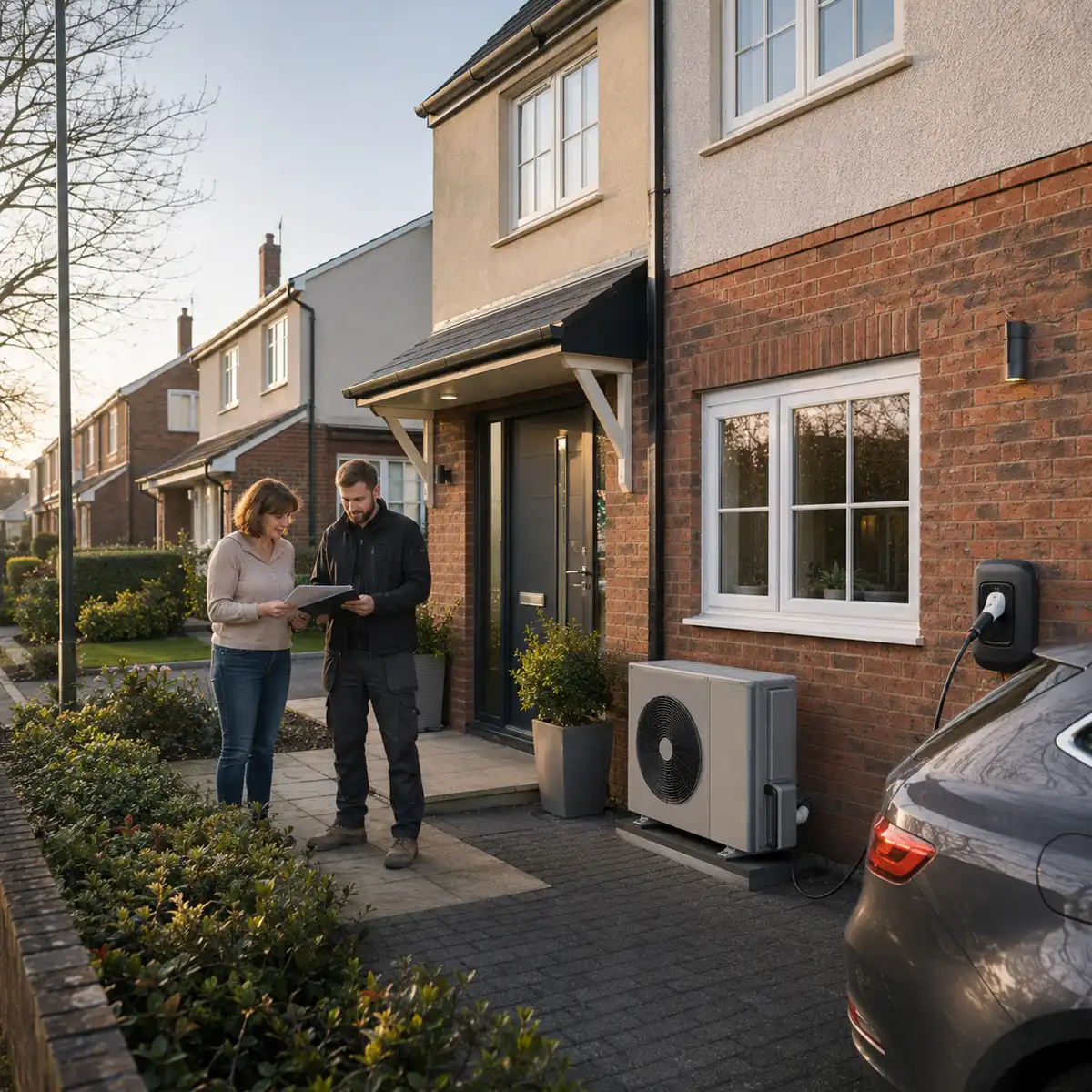
Beyond electricity, recent reductions have come from surface transport. The CCC noted in 2025 that one in five new vehicles sold in the UK is now electric, and that for the first time, transport emissions have declined even as journey volumes have risen. Tree planting rates increased by 56% in 2024, concentrated in Scotland. Heat pump installations rose 56% over the same period under the Boiler Upgrade Scheme. The direction of travel is positive across multiple sectors.
The structural problem identified by the CCC is concentrated in three areas. First, only 18% of UK total energy demand is met by electricity, against a Balanced Pathway requirement that this share rises sharply. Second, only 1% of UK homes have a heat pump, against installation rates many times higher across the rest of Europe. Third, around 80% of the remaining emissions reductions required to reach the 2030 NDC must come from sectors beyond energy supply, where decarbonisation has barely begun in earnest. The first three carbon budgets were met. The Fourth Carbon Budget (2023 to 2027) is on track to be overachieved. The challenge sits with the Fifth, Sixth and Seventh.
The Seventh Carbon Budget and the Balanced Pathway
The CCC's Seventh Carbon Budget advice is significant for two reasons beyond the numerical target. The first is the methodological shift: where earlier carbon budgets were accompanied by several illustrative pathways (Headwinds, Tailwinds, Balanced), the CCC now publishes a single updated Balanced Pathway with uncertainty analysis. The Committee's view is that the optimal technologies and actions are now largely settled, and that the remaining flexibility lies mostly in how aggressively each lever is pulled rather than which levers exist.
The Balanced Pathway expects roughly 60% of cumulative emissions reductions to 2050 to come from electrification of transport, heating, and industry, powered by an electricity system roughly double the size of today's. Around 25% comes from demand-side measures: energy efficiency, walking and cycling, dietary shift, and carbon pricing on flights. Around 5% comes from nature restoration. The remainder comes from low-carbon fuels, carbon capture and storage, and engineered greenhouse gas removals. UK grasslands and woodlands currently remove approximately 27 megatonnes of carbon dioxide per year; engineered removals stand at effectively zero today and need to reach roughly 17 megatonnes per year by 2050.
On cost, the CCC estimates the Balanced Pathway adds around £4 billion per year in capital and operating expenditure between 2025 and 2050, averaging 0.2% of GDP using Office for Budget Responsibility methodology. The CCC published a Supplementary Analysis on 11 March 2026 in response to public misunderstanding of those figures. It concluded that benefits outweigh costs by a factor of 2.2 to 4.1 times, with avoided climate damages alone estimated to save between £40 billion and £130 billion in 2050. The supplementary analysis was framed as a methodological clarification rather than a revision.
The Carbon Budget and Growth Delivery Plan
On 29 October 2025, DESNZ published the Carbon Budget and Growth Delivery Plan to address the 39% policy gap identified by the CCC. The Plan sets out the framework for meeting Carbon Budgets Four, Five and Six, covering the period 2023 to 2037, and integrates this with the 2030 and 2035 NDCs registered under the Paris Agreement. It was published shortly before COP30 in Belem, with the international audience clearly in view.
The Plan introduced an Investor Prospectus alongside the policy framework, designed to make the sectoral investment case visible to private capital, and a UK Methane Action Plan covering domestic and international mitigation. It also contains the government response to the CCC's 2025 Progress Report, accepting some recommendations directly and committing to others through subsequent secondary legislation or scheme design. The Climate Change Committee's initial response from its Chair, Piers Forster, welcomed the Plan as comprehensive but reserved full assessment for the CCC's own 2026 Progress Report. That assessment is the next decisive moment in the policy cycle, expected in June 2026.
Significant structural questions remain. The Warm Homes Plan, the government's framework for residential decarbonisation, was delayed from spring 2025 into autumn and remains the policy instrument most directly tied to the heat-pump deployment rates the CCC says are required. The Environmental Audit Committee, reporting on 4 March 2026, judged the CCC's Seventh Carbon Budget recommendation 'technically credible' but noted that delivery now depends 'on tough political decisions' and on inter-departmental policy alignment that has been inconsistent in recent years.
Where the evidence base remains contested
Three policy debates currently sit on contested evidence rather than settled science. The first is on demand reduction. The CCC's Balanced Pathway counts on roughly 25% of cumulative emissions reductions coming from demand management, including a frequent-flyer levy and reduced meat and dairy consumption. Research from the Priestley Centre for Climate Futures noted in July 2025 that 65% of aviation emissions reductions in the next five years on the Balanced Pathway depend on demand management policies that do not yet exist in statute. Whether the political ground supports them is a question the evidence base cannot settle by itself.
The second debate is on greenhouse gas removals. The Balanced Pathway needs engineered removals (Bioenergy with Carbon Capture and Storage, Direct Air Capture, Energy from Waste with CCS) to scale from effectively zero to 17 megatonnes per year by 2050. The infrastructure to transport and inject captured CO2 underground is partially under construction in the East Coast and HyNet clusters, but the deployment timeline is tight. CO2RE researchers and others have argued the Balanced Pathway sits at the lower end of plausible engineered-removal deployment; whether the upper end is achievable depends on capital allocation decisions not yet made.
The third debate is on cost. The 0.2% of GDP figure has been challenged from both directions: critics of the net zero programme argue the cost is understated because it excludes household transition friction; CCC defenders argue the figure overstates net cost because it does not properly value avoided fossil-fuel volatility. The March 2026 Supplementary Analysis addressed some of these criticisms but did not close the methodological argument. The evidence on net cost favours the CCC's framing, but the political argument about who bears the cost in the early years remains live.
What this means for UK readers
The translation from carbon budget to household reality runs through three policy instruments. The Boiler Upgrade Scheme funds heat pump installation. The Zero Emission Vehicle Mandate sets manufacturer-level sales thresholds rising to a 2035 phase-out date for new internal-combustion-engine vehicles. Contracts for Difference allocate strike-price contracts to renewable electricity generators, transferring market-price risk from generator to consumer in exchange for long-term capacity build-out. Each of these is its own policy story; together they are how the abstract Balanced Pathway becomes specific decisions for households and businesses.
Beyond residential decarbonisation, the structural shift affects every sector. The Sizewell C nuclear project, with first power expected in the mid-2030s, is one part of the dispatchable low-carbon capacity the system requires. Sizewell C alone will not deliver net zero electricity, but the Balanced Pathway does not work without a clear contribution from new nuclear alongside the dominant renewable build-out. The biodiversity, agricultural and land-use elements of the pathway, including the Environmental Land Management scheme and Biodiversity Net Gain in development planning, are how the 5% from nature restoration is delivered. The whole architecture rests on the 2008 Climate Change Act remaining politically intact across electoral cycles.
Fun fact: When the UK passed the Climate Change Act in 2008, no other major economy had a long-term, statutorily binding emissions reduction target framework. By 2026, more than 90 countries had adopted similar frameworks, many borrowing directly from the UK's five-year carbon budget architecture.
What to watch over the next twelve months
Three calendar dates frame the next phase. Parliament must approve or reject the Seventh Carbon Budget level by 30 June 2026. The CCC's 2026 Progress Report will assess the Carbon Budget and Growth Delivery Plan in its first full evaluation, likely in late June 2026. The Warm Homes Plan, delayed from earlier in 2025, will set the speed of residential decarbonisation for the remainder of the decade. None of these dates resolves the policy debate; each makes the next round of it more specific. The honest summary of the UK net zero strategy in 2026 is that the target remains intact, the legal framework remains intact, the technology pathway is increasingly settled, and the delivery gap on the 2030 NDC is real, named, and quantified. The next year will tell us whether it closes.
Internal link placements
how Contracts for Difference allocate strike-price contracts to renewable generators
how Biodiversity Net Gain delivers the nature restoration element
how Sizewell C contributes dispatchable low-carbon capacity
Related reading: Inside the UK Net Zero Strategy and What It Delivers.
Continue Reading
All articles →Newsletter
Stay updated on Digital News