UK greenhouse gas emissions were 50.4% below 1990 levels by the end of 2024, the first G7 economy to cut its emissions in half. That single number sits at the centre of the UK net zero strategy and explains both why the country is often praised for climate leadership and why its own independent advisers warn that the next decade will be harder than the last one. The Climate Change Committee's 2025 Progress Report to Parliament, published on 25 June 2025, found that 61% of the emissions reductions the UK needs to make by 2030 are backed by credible government policy. The remaining 39% are either at high risk of non-delivery or rest on proposals that have not yet been turned into policy at all.
That gap between what the UK has committed to and what the UK has a realistic plan to deliver is the defining feature of net zero policy in 2026. This article explains what the UK net zero strategy actually consists of, which institutions hold which responsibilities, how the policy architecture has evolved since the Climate Change Act 2008, and what the independent Climate Change Committee says about whether the country is on course.
What the UK net zero target legally requires
The UK's net zero target is set out in the Climate Change Act 2008, as amended by the Climate Change Act 2008 (2050 Target Amendment) Order 2019. The 2019 amendment changed the original 80% emissions reduction target to a full 100% reduction by 2050, measured against a 1990 baseline, and made the UK the first G7 economy to legislate for net zero.
The Act does not set out how to achieve net zero. It sets the endpoint and requires the government to meet a series of five-year carbon budgets on the way there. Each budget is a legally binding cap on the total greenhouse gases the UK can emit over that period. The budgets are set on advice from the Climate Change Committee, an independent statutory body established by the same Act. If the government misses a budget, the Secretary of State has to explain why to Parliament and set out how the missed emissions will be recovered in future budgets.
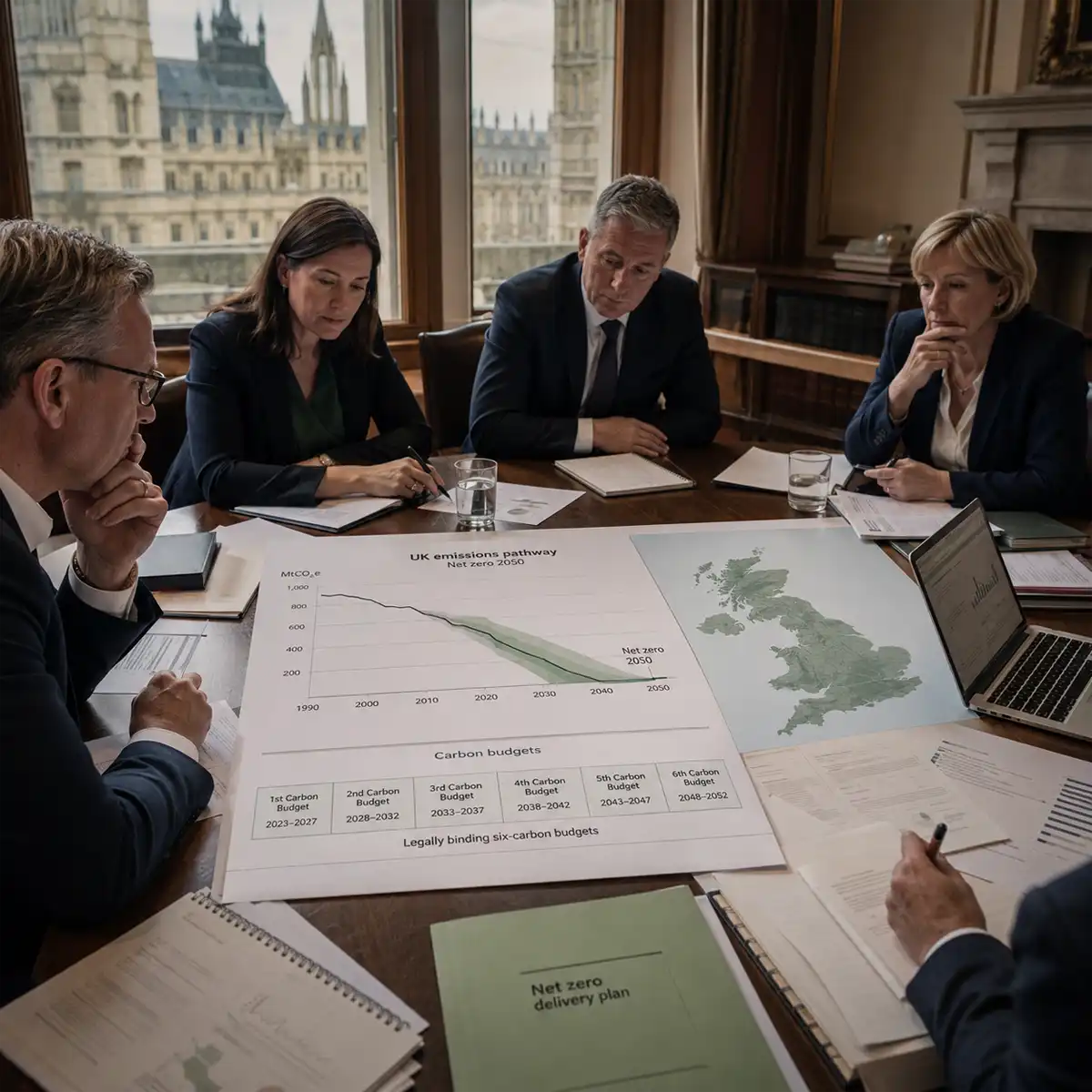
Six carbon budgets have been legislated so far. The UK has met the first three (covering 2008 to 2022) and, as of 2023, is on track to overachieve the fourth (2023 to 2027). The fifth covers 2028 to 2032. The sixth, covering 2033 to 2037, is the most demanding yet, requiring a 78% emissions reduction from 1990 levels by 2035. In February 2025 the Climate Change Committee published its advice on the seventh carbon budget, covering 2038 to 2042, which would require an 87% reduction by 2040.
The Committee estimates that delivering the seventh carbon budget pathway would cost the UK an annual average of 0.2% of GDP between 2025 and 2050. That figure sits inside the active political debate over the cost of net zero and is one of the more consequential pieces of independent analysis the Committee has produced.
Who holds the powers and who holds the scrutiny
Net zero delivery in the UK is distributed across several departments and statutory bodies rather than concentrated in one climate ministry. This is a deliberate design choice and a consistent source of policy friction.
The Department for Energy Security and Net Zero holds the central policy lead. It was split out from the former Department for Business, Energy and Industrial Strategy in February 2023 and took on responsibility for energy policy, the net zero strategy, and carbon budget delivery. The Department for Environment, Food and Rural Affairs covers land use, agriculture, and biodiversity. The Department for Transport owns the decarbonisation of surface transport and aviation. The Department for Science, Innovation and Technology funds much of the low-carbon research programme through UK Research and Innovation. HM Treasury retains the fiscal levers.
Independent scrutiny sits with the Climate Change Committee under its statutory duty to report annually to Parliament on progress and to advise on the level of each carbon budget. The current chair is Piers Forster, a climate scientist at the University of Leeds. Parliamentary scrutiny sits with the Environmental Audit Committee and the Energy Security and Net Zero Committee in the Commons, and the Environment and Climate Change Committee in the Lords. The Office for Budget Responsibility provides the fiscal scrutiny, most recently in its 2024 Fiscal Risks and Sustainability report and its March 2026 Spring Forecast commentary.
The architecture has one feature worth highlighting. The Climate Change Committee can tell Parliament the government is off track, but cannot compel delivery. The High Court can rule that a net zero strategy fails the Climate Change Act, as it did in July 2022 and again in May 2024, but cannot write the replacement plan. The power to deliver sits with ministers; the power to scrutinise sits with the Committee and the courts. That division is how British climate governance was designed and is both its strength and its recurring weakness.
What the current plan actually says
The UK's current net zero plan is the Carbon Budget and Growth Delivery Plan, published by the government on 29 October 2025. It replaces the 2023 Carbon Budget Delivery Plan, which the High Court ruled unlawful in May 2024 on the grounds that it did not demonstrate a realistic pathway to meeting the fourth, fifth, and sixth carbon budgets.
The 2025 plan restructures delivery around five headline programmes. Great British Energy, established under the Great British Energy Act 2025, is a publicly owned energy generation company tasked with accelerating renewable deployment, with profits returned to the Exchequer. The Clean Power 2030 Action Plan commits to a largely decarbonised electricity grid by 2030. The Warm Homes Plan, delayed from spring 2025 to autumn 2025, sets the framework for domestic heat decarbonisation. The industrial strategy published in June 2025 designates carbon capture, usage and storage (CCUS) as a priority sector. A revised Net Zero Investment Strategy sets out how the government intends to mobilise private capital at the scale the CCC assessment requires.
The Climate Change Committee's chair welcomed the 2025 plan as more comprehensive than its 2023 predecessor and committed the Committee to a full assessment in its 2026 progress report. The CCC's June 2025 Progress Report, which assesses the earlier plan, concluded that 69% of the total UK emissions reduction against 1990 has been achieved since the Climate Change Act was passed in 2008, and that the rate of decarbonisation has more than doubled under the Act. That trajectory is what makes the 2050 target credible, in the CCC's assessment, provided the government stays the course.
What the UK net zero strategy actually means
The UK net zero strategy is the combined legal and policy framework that commits the country to reducing its net greenhouse gas emissions to zero by 2050. It rests on the Climate Change Act 2008, six legislated carbon budgets, the 2025 Carbon Budget and Growth Delivery Plan, and independent scrutiny by the Climate Change Committee.
That definition matters because public debate routinely treats 'net zero' as a single government project that could be cancelled or deferred. In legal terms it is considerably harder to unwind. The 2050 target is in primary legislation. The carbon budgets covering the next fifteen years are already set. Withdrawal from any of them would require new legislation, which in turn would require the government of the day to accept the political cost of being seen to walk away from the Climate Change Act architecture. No UK government has done so. The Conservative government's 2023 adjustments to the 2030 petrol and diesel ban and the phase-out date for fossil fuel heating did not touch the 2050 target itself, and the Labour government elected in July 2024 retained the target on taking office.
Where the emissions cuts have actually come from
The CCC's 2025 Progress Report is the authoritative UK source on what has and has not delivered. The headline finding is that the electricity supply sector has done most of the work. Emissions from electricity generation fell by 17% in 2024 alone, driven by the closure of the UK's last coal-fired power station at Ratcliffe-on-Soar in September 2024 and the continued expansion of offshore wind. That sector is now the UK net zero success story.
Surface transport is the second area of tangible progress. A fifth of all new vehicles sold in the UK in 2024 were electric, and the CCC found that, for the first time, total transport emissions fell even as people travelled more. The Zero Emission Vehicle Mandate, which entered into force in January 2024, requires manufacturers to sell an increasing proportion of zero-emission vehicles each year, starting at 22% of new cars in 2024 and rising to 80% in 2030. That mandate, not the 2035 ban on new petrol and diesel car sales, is the live policy instrument doing the decarbonisation work.
Tree planting increased 56% in 2024, mainly in Scotland. Heat pump installations were also up 56%, although the absolute numbers remain small: only around 1% of UK homes had a heat pump by the end of 2024, compared with more than 15% in Sweden and Finland. That gap is the defining measure of how far the UK has to travel in building decarbonisation.
Where the plan is weakest according to independent scrutiny
The CCC's critical findings in its June 2025 report cluster around four areas. First, domestic heat. The UK has failed to scale heat pump deployment at the pace required, and the Warm Homes Plan has been repeatedly delayed. The Committee has called for the removal of policy costs from electricity bills, which currently makes electricity roughly four times the price of gas per unit of energy, as the single highest-impact change the government could make to shift households off gas.
Second, surface transport beyond cars. Freight, aviation, and shipping are not yet on a credible decarbonisation pathway in the UK. The CCC has urged the government to develop policy to address aviation emissions, including incorporating the full climate cost of flying into air passenger duty and industry charges.
Third, land use and agriculture. The CCC flagged that peatland restoration and tree planting rates, while improving, are still below the trajectory required by the sixth carbon budget, and that agricultural emissions have barely moved in a decade. The Environmental Land Management scheme, which replaced the Common Agricultural Policy in England after Brexit, is intended to address this but has run into design and adoption problems.
Fourth, engineered carbon removals. The UK's net zero pathway assumes a significant contribution from carbon capture, usage and storage and from direct air capture. The CCC welcomed the industrial strategy's designation of CCUS as a priority sector but noted that the business models for engineered removals have not yet been finalised and that the scale of delivery implied by the carbon budgets is untested at commercial scale.
What UK net zero means for households and businesses
The net zero programme is not an abstraction. It is reshaping UK household and business decisions in 2026 and will continue to do so for the rest of the decade. Three threads matter most.
Energy bills are the most immediate. The structure of the UK electricity market, inherited from the 2013 Electricity Market Reform, means that the wholesale price is typically set by the marginal gas plant, which keeps electricity prices tied to gas prices even as more of the generation mix becomes renewable. The Review of Electricity Market Arrangements, under way since 2022, is the mechanism that could change this. Its outcome, still pending in 2026, will determine how much of the cost of renewable deployment flows through to household and business bills.
Transport is the second thread. The ZEV Mandate is already reshaping the UK new car market; the broader question is whether the charging infrastructure will keep pace. The CCC found that public charging capacity has grown, but unevenly, with most of the capacity clustered in London and the South East. For drivers in rural areas and the devolved nations, the effective availability of EV charging is a separate question from the headline number.
Buildings are the third and hardest thread. The UK has 27 million homes, around 85% of which are heated by natural gas. Net zero cannot be achieved without addressing this, and the policy framework for doing so, which links the Warm Homes Plan, the Boiler Upgrade Scheme, and the removal of planning barriers for heat pumps, is still being assembled in 2026. For homeowners and landlords, the decisions made in this Parliament will shape the practical obligations and the available subsidies for the next decade.
Fun fact: The UK became the first G7 country to phase out coal-fired electricity generation when Ratcliffe-on-Soar power station closed on 30 September 2024, ending 142 years of coal power in Britain. The first coal-fired station in the world, Thomas Edison's Holborn Viaduct plant, opened in London in 1882.
Conclusion
The UK net zero strategy in 2026 is further along than its critics often concede and further behind than its targets require. The Climate Change Act 2008 has delivered a halving of emissions in under two decades, and the independent Climate Change Committee has concluded that the 2050 target remains within reach. What is also true is that the easier wins have now been made. The harder ones, heat pumps in 27 million homes, decarbonised aviation, agricultural change, and engineered carbon removal at commercial scale, are all still ahead. The 2026 CCC progress report, due in June, will give the first formal independent verdict on the 2025 Carbon Budget and Growth Delivery Plan. That report, the Warm Homes Plan implementation, and the outcome of the Review of Electricity Market Arrangements are the three things to watch over the next twelve months. The map of the UK net zero strategy has been drawn. The question now is whether the country has the patience and the political will to walk the route.
Biodiversity Net Gain
Nature Restoration Fund
Ofcom Online Safety Act enforcement
Related reading: UK net zero strategy explained for 2026 readers, What the UK National Wealth Fund is designed to do.
Continue Reading
All articles →Newsletter
Stay updated on Digital News